


Designer Eyeglasses vs Sunglasses: Do You Need Both?
Most people in the UAE own at least one pair of sunglasses and one pair of glasses, and many assume the two can do each other's job. They cannot. A designer sunglass on a face that needs correction gives you blur or a constant squint, and a clear designer frame on a bright Dubai afternoon gives you glare and tired eyes. If you are shopping for designer eyeglasses in the UAE, the first decision is not which brand to buy but which problem you are solving, and whether one pair can solve both.
Table of Contents
- Quick Takeaways
- Why the Two Pairs Are Not Interchangeable
- When Sunglasses Alone Are Enough
- Prescription Sunglasses: The One-Pair Compromise
- Designer Eyeglasses and Prescriptions in Dubai
- Comparing Your Options Side by Side
- Building a Wardrobe Without Wasting Money
- Frequently Asked Questions
- References
Quick Takeaways
| Key Insight | Explanation |
|---|---|
| Sunglasses protect, they do not correct | A tint reduces light and glare but does nothing for blurry distance or near vision. If you need glasses to read road signs, a plain sunglass leaves you guessing. |
| Prescription sunglasses are the one-pair option | They cover both jobs, but only if your prescription is stable and you wear the same frame most days. |
| Keep a clear pair for indoor and screen work | Offices, malls, and evenings at home need clear lenses with an anti-reflective coating, not a tint. |
| Check for UV protection before you check the logo | Darkness alone does not protect your eyes. A dark lens without UV filtering can make your pupil open wider and let in more UV. |
| Choose the lens type before the frame | A strong prescription in a large round frame gets thick at the edge. A high-index lens or a smaller frame often solves the problem. |
| Two pairs usually beat one stretched pair | If you wear glasses full time indoors and sunglasses outdoors, a second pair costs less than the eye strain from using the wrong one. |
Why the Two Pairs Are Not Interchangeable
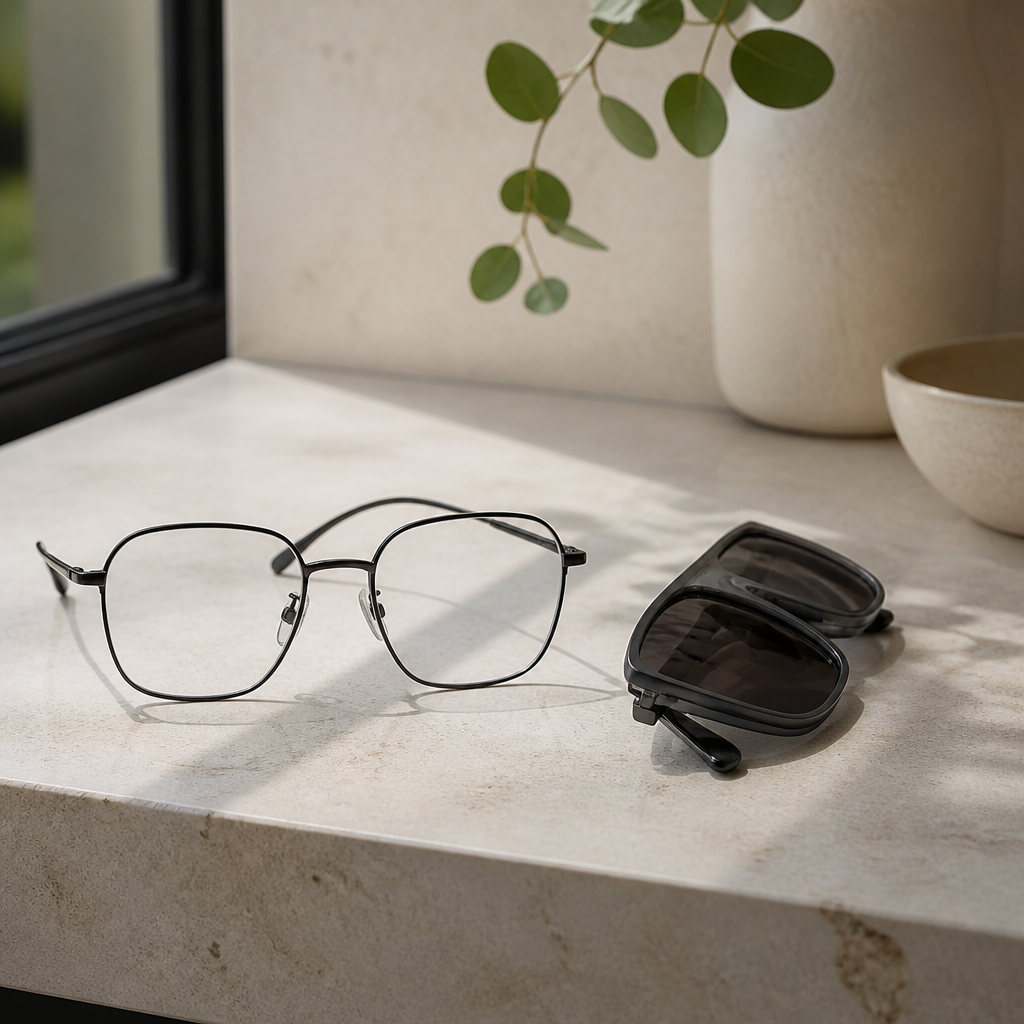
Sunglasses and eyeglasses sit side by side in the same shop, but they solve two different problems. Sunglasses reduce light and cut glare, and any good pair should also block UV rays. Eyeglasses correct how your eye focuses light, which is a separate job entirely. A tinted lens will not sharpen a blurry view, and a clear lens will not stop the glare off the sea or a bright windscreen.
What Regular Sunglasses Actually Do
Regular sunglasses earn their place outdoors. A quality pair blocks UV, reduces brightness, and keeps wind, sand, and dust away from your eyes. They do nothing for focus. If you have an uncorrected prescription, a plain sunglass leaves your vision as blurred as it was indoors, which is why people who need correction often end up wearing their clear glasses under a sunglass clip or carrying two pairs everywhere.
What Eyeglasses Actually Do
Eyeglasses correct refractive errors such as nearsightedness, farsightedness, astigmatism, and presbyopia. Most people who need them use them for reading, screens, driving at night, and most indoor tasks. Clear lenses with a good anti-reflective coating handle these jobs well, but they offer little protection against harsh midday sun, so they are a poor substitute for a sunglass in summer.
Pro tip: Ask your optician whether your prescription was measured with the frame's fitting position in mind. A lens sitting a few millimetres off your pupil can blur the edges even when the strength is correct.
When Sunglasses Alone Are Enough
If you already see clearly without help, a well-made sunglass covers most outdoor needs. Plenty of our customers buy a designer sunglass for weekend drives, beach days, and the walk from the car to the mall, and never need a prescription at all. The sunglass becomes the one piece of eyewear that does real work, and the question is simply how well it is built.
Who Can Skip the Prescription Entirely
The clearest case is someone who has never needed glasses and has no eye condition that changes their vision. For that person, a sunglass with proper UV protection and a frame that sits close to the face is enough. Wraparound or close-fitting styles block light from the sides, which matters on a sunny terrace or a long open road. A large fashion frame with a dark, non-polarized lens works well for lounging, but it will not reduce reflected glare from a wet road as well as a polarized lens will.
Where the Sunglass-Only Plan Breaks Down
The plan fails when you need glasses to read a phone, use a laptop, or drive after dark. Squinting through a tint that is too dark for the task is a common reason people get headaches. In practice, the most frequent mistake we see is buying a second sunglass to fix a vision problem that a prescription would have solved. A new frame will not make distant road signs readable.
Pro tip: Look for a UV rating or a clear UV400 label on any sunglass before you buy, even a fashion frame. Dark tint without UV filtering is worse than a clear lens, because it makes your eyes open wider in the sun.
Prescription Sunglasses: The One-Pair Compromise
Prescription sunglasses combine corrective lenses with sun protection in one frame. For people who need correction and spend much of the day outdoors, they can replace a second pair entirely. The trade-off is that the tint and the prescription are locked together, so a change in either usually means a new pair.

Lens Options That Actually Matter
Three lens types do most of the work. Polarized lenses cut reflected glare from roads, water, and car bonnets, which is why many drivers prefer them. Solid grey or brown tints suit general bright light and keep colours looking natural. Photochromic lenses darken outdoors and clear indoors, which suits people who move between offices and streets several times a day. Choose the tint first, then add the prescription.
The best eyewear is the pair you wear every day without thinking about it, and that usually means the lens matches the job, not the logo.
Where Prescription Sunglasses Fall Short
They are not the best fit if your prescription changes often, if you need a strong correction that makes a dark tint heavy on the face, or if you spend hours on screens. Photochromic lenses also darken slowly behind a windscreen, because the glass blocks much of the UV that triggers them, so they may not get dark enough while driving. Many drivers find a dedicated polarized sunglass more comfortable on the road and keep their prescription sunglass for walking and errands.
Designer Eyeglasses and Prescriptions in Dubai
Designer eyeglasses UAE buyers usually choose by brand and frame shape first, which is a reasonable place to start. For luxury buyers looking for prescription glasses in Dubai, though, the prescription decides whether a frame will work day after day. Brands such as Ray-Ban, Prada, Dior, Emporio Armani, and Porsche Design each cut frames differently, and the same lens can look thick or thin depending on the bridge width and the eye size.
Frame Size and Lens Thickness
A stronger prescription in a large or deeply curved frame produces a thicker lens edge. A higher-index lens material keeps the rim slimmer, and a smaller frame with a deeper bridge is usually the more comfortable option for a strong correction. Ask about lens index before you ask about frame colour. The frame you love may not be the frame your prescription can support.
Pro tip: Note how far your current glasses sit from your eyes, which opticians call the vertex distance. If a new frame sits much further forward or back, the lens can feel stronger or weaker than your old pair even with the same prescription.
Why Designer Frames Still Need a Proper Fitting
An authentic frame is only half the job. Your pupillary distance, the position of the lens in front of the eye, and the tilt of the frame all affect how clear the lens feels. Do not skip the fitting step, even when you order online. A frame that sits crooked can blur one side of your vision for as long as you wear it, and no amount of cleaning fixes that.
When a customer orders a prescription pair, we recommend sending the prescription and a photo of the frame on the face before the lenses are cut. Checking the fit early costs far less than remaking a lens.
Comparing Your Options Side by Side
Three realistic setups cover most buyers. The table below compares them on the factors that usually decide the purchase, which are how often you wear each pair, how well the setup handles bright light, and how many frames you need to carry.
| Setup | Best For | Main Trade-off |
|---|---|---|
| Separate eyeglasses and sunglasses | Strong prescriptions and people who work indoors on screens | Two pairs to buy, store, and clean |
| Single prescription sunglasses | Outdoor-heavy wearers with a stable prescription | Tint and prescription are tied together, so upgrades cost more |
| Clip-on or over-sunglasses | Occasional wearers who want to keep one frame | Extra weight, and the clip can slip on a sweaty face |
The separate pair is the most flexible option, while prescription sunglasses are the most efficient for people outside most of the day. Clip-ons are the cheapest way to add sun protection to a frame you already own, but they are rarely the most comfortable choice for long days.
Which Setup Fits Your Week
If you drive, walk between buildings, and work in an air-conditioned office, you will probably want separate pairs. If your weekends are mostly outdoors and your weekdays involve short bursts of screen time, a single prescription sunglass can cover most of what you need. Look at your calendar for the last month and count the hours spent in each setting before you decide.
Cost Per Wear Is the Real Measure
A less expensive frame worn every day beats an expensive frame sitting in its case. Count how many days a week each pair will be used, then compare the price per wear rather than the sticker price. We offer free delivery across the UAE and a 7-day return window, so you can check the frame and the fit at home before you commit. Check the return terms for prescription items before ordering, since custom lenses can be handled differently.
Building a Wardrobe Without Wasting Money
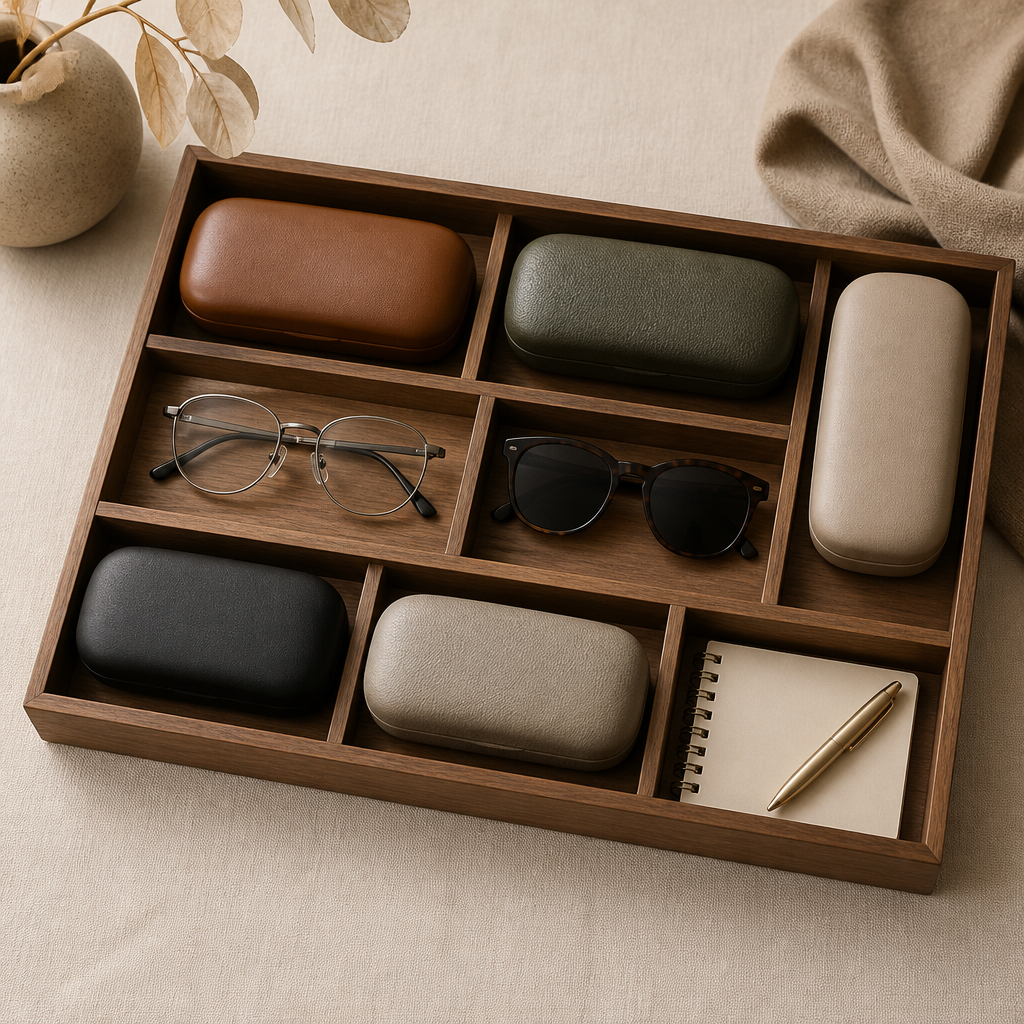
The most efficient wardrobe for most UAE residents is one clear pair, one everyday sunglass, and, if you need correction, one prescription sunglass. That combination avoids buying a third pair that duplicates the first two. Start with what you use most, and add a new category only when you find a real gap.
The Two-Pair Setup for Daily Wearers
Someone who needs strong correction, works on screens, and spends time outside should own a prescription eyeglass for indoors and a prescription sunglass for outdoors. The eyeglass can carry an anti-reflective coating suited to screen work, while the sunglass focuses on tint and polarization. When your eye doctor updates one prescription, update the other at the same time so your vision does not shift between pairs.
Pro tip: Keep your sunglass case in the bag or the cabin, not on the dashboard. Prolonged heat can warp acetate frames and loosen hinges, which is a common reason designer pairs need early repairs.
The One-Pair Setup for Occasional Wearers
If you only need correction for distance driving or the occasional evening event, a single prescription sunglass with photochromic lenses can cover indoor and outdoor use. Expect some compromise on indoor clarity, since a lens that adapts to light is rarely as crisp as a dedicated clear lens. Test the lens in the frame you intend to wear, not just the one that looks best in the mirror.
Frequently Asked Questions
Can I wear designer sunglasses over my eyeglasses?
Yes, over-sunglasses and clip-ons work, but they add weight and can slip, especially in heat. For daily wear, a prescription sunglass is more comfortable and less fussy.
Do I need prescription sunglasses if I only use reading glasses?
Usually not. Reading glasses are built for close work, and a tinted reading lens is an unusual setup. Keep a clear reading pair for indoor tasks and use a plain sunglass outdoors unless you read outside often.
Does a darker lens mean better UV protection?
No. Darkness reduces brightness, but UV protection comes from the lens material or coating. A very dark lens without UV filtering lets your pupil widen, which can increase the UV that reaches your eye.
Are polarized lenses necessary for driving in the UAE?
They are not required, but they reduce reflected glare from the road, bodywork, and water, which many drivers find more comfortable on long trips. Some vehicle screens look dim through polarized lenses, so test your frame in the car before you rely on it.
How often should I update my prescription sunglasses?
Update them whenever your eye care professional changes your prescription, and follow the eye exam interval they recommend. A sunglass with an outdated prescription can cause eye strain even when the frame and tint are right.
Can I order prescription eyeglasses online and still get a good fit?
Yes, provided your prescription is current and your fitting measurements are accurate. Send a clear photo of the frame on your face when possible, and read the return terms for custom lenses before you order.
Tell us in the comments whether you own one pair or two, and which one you reach for first on a hot Dubai afternoon.
We would love your feedback and any insights you would share with others. What perspective would you add?


