


How to Care for Designer Sunglasses: Full Guide
You spent real money on your Ray-Ban Aviators, your Prada cat-eyes, or your Porsche Design titanium frames. The last thing you want is to ruin them with a dirty shirt hem and a moment of carelessness. Knowing how to care for designer sunglasses is not complicated, but most people get at least one thing badly wrong, and that one mistake, repeated daily, is what turns a pristine pair into a scratched, warped disappointment inside six months. This guide covers every aspect of luxury eyewear maintenance, from daily cleaning to long-term storage, so your investment holds its value and its clarity for years.
Table of Contents
- Quick Takeaways
- Why Designer Sunglasses Need Special Care
- How to Clean Sunglasses Correctly
- Storing Your Sunglasses the Right Way
- Handling and Frame Care
- What to Avoid: The Damage List
- Cleaning Methods Compared
- Frequently Asked Questions
- References
Quick Takeaways
| Key Insight | Explanation |
|---|---|
| Always use a microfiber cloth | Paper towels, tissues, and clothing fibers carry grit that scratches lens coatings permanently. A clean microfiber cloth is the only safe option for daily wiping. |
| Rinse before wiping | Dry-wiping a dusty lens drags abrasive particles across the surface. A quick rinse with lukewarm water first removes loose debris safely. |
| Avoid heat above 60°C | Leaving sunglasses on a car dashboard in the UAE summer exposes them to temperatures that warp acetate frames and degrade lens coatings and polarization layers. |
| Never use household cleaners | Ammonia-based cleaners (like window spray), acetone, rubbing alcohol, and vinegar strip anti-reflective, polarization, and UV-protective coatings from premium lenses. |
| Use both hands when removing your sunglasses | Pulling frames off with one hand stresses the hinges unevenly and gradually bends the temple on the pulling side, causing a permanent misfit. |
| Store in a hard case, lenses facing up | A soft pouch prevents dust but offers no crush protection. A hard case with the lenses facing up (not down) prevents scratches and frame distortion during travel. |
| Check and tighten screws regularly | Hinge screws loosen with daily use. A small precision screwdriver (included in most eyewear kits) and a quarterly check prevents the frame from becoming loose or misaligned. |
Why Designer Sunglasses Need Special Care
Premium sunglasses from brands like Ray-Ban, Prada, Dior, and Emporio Armani are engineered products, not just fashion items. The lenses carry multiple coating layers: UV filtration, polarization films, anti-reflective treatments, mirror finishes, or photochromic chemistry. Each of these layers is chemically sensitive and physically thin. Once damaged, they cannot be repaired, only replaced, and replacement lenses cost a significant fraction of the original frame price.
The frames themselves, whether Italian acetate, lightweight titanium, or injected nylon, have specific tolerances. Acetate can warp under sustained heat. Metal hinges can fatigue if repeatedly stressed in the wrong direction. Understanding that you are caring for a precision optical instrument, not just an accessory, changes how you approach every interaction with your sunglasses.
In the UAE context, there are two threats that accelerate damage faster than almost anywhere else: extreme heat and airborne sand. A car interior in Dubai or Abu Dhabi can reach temperatures that soften acetate frames and begin degrading lens coatings within minutes. Sand particles, invisible to the eye on a lens surface, act like fine sandpaper the moment you wipe without rinsing first. Both threats are entirely manageable once you know what you are dealing with.

How to Clean Sunglasses Correctly
Cleaning is where most damage happens, and most of it is avoidable. The process itself takes under two minutes when done properly. The shortcut everyone takes, grabbing the nearest fabric and wiping, is exactly what causes the fine web of scratches that accumulates over months and blurs the clarity of even the best lenses.
The correct step-by-step cleaning process
Step 1: Wash your hands first. Oils, sunscreen residue, and grit on your fingers transfer directly to the frame and lenses. This step takes ten seconds and eliminates a major source of contamination.
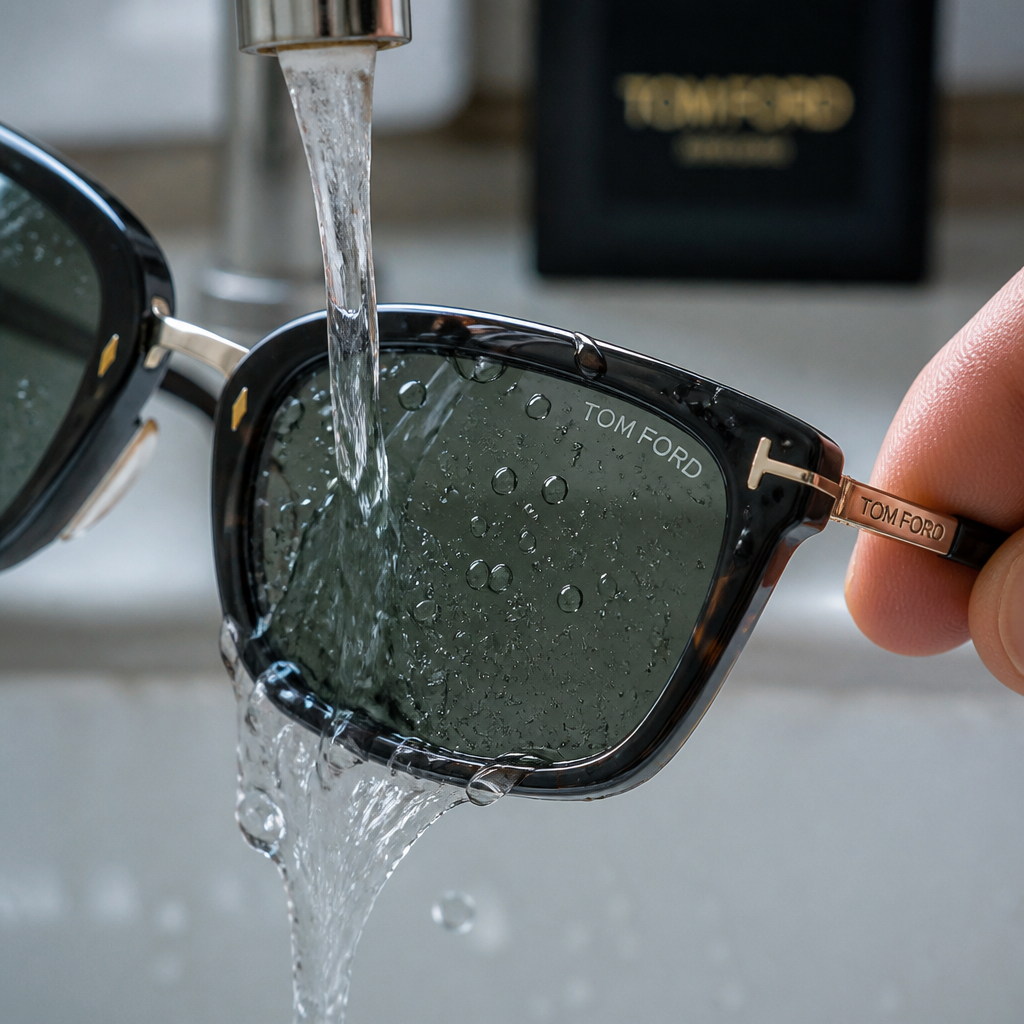
Step 2: Rinse with lukewarm water. Hold the frames under a gentle stream of lukewarm water, covering both sides of the lenses and the frame. This floats off dust and sand before you touch the surface. Do not use hot water. Hot water can damage coatings, particularly on polarized lenses, and can soften acetate frames over time.
Step 3: Apply a single drop of mild dish soap. Place one small drop on each lens and work it gently across the lens and frame with your fingertips. Use soap without lotions, moisturizers, or other additives. Eyewear-specific cleaning spray is an equally good alternative. Avoid anything containing ammonia, alcohol, acetone, or vinegar.
Step 4: Rinse thoroughly. Rinse again under lukewarm water until all soap residue is gone. Leftover soap dries into streaks, which then require another cleaning cycle.
Step 5: Dry with a clean microfiber cloth. Pat gently rather than rubbing. Make sure the cloth itself is clean. A microfiber cloth that has been used to wipe down a dusty surface has accumulated particles that will scratch lenses just as effectively as paper towel.
Pro tip: Keep a spare, dedicated microfiber cloth inside your sunglasses case and wash it weekly with mild soap. A contaminated cloth is just as damaging as using no cloth at all.
Cleaning polarized and mirror-coated lenses
Polarized lenses have a film embedded in or applied to the lens that requires gentle handling. Excessive rubbing pressure, or any solvent-based cleaner, can cause the polarization layer to delaminate or develop spots. The same risk applies to mirror-finish lenses, where the metallic coating sits on the outer surface and is especially vulnerable to anything abrasive or chemically harsh.
For both lens types, use only water and mild soap or a lens spray explicitly labeled safe for coated lenses. When in doubt, rinse and pat dry with microfiber only, no soap at all. A faint smudge is far preferable to a delaminated coating.
Dealing with sunscreen and saltwater residue
Sunscreen and sweat are two of the most corrosive substances regularly in contact with eyewear. Both contain chemicals and oils that attack lens coatings and nose pad materials with repeated exposure. Saltwater, whether from the sea or from perspiration drying on the frame, leaves mineral deposits that etch into surfaces if left to sit.
After any beach day, poolside session, or outdoor activity involving sunscreen, rinse your sunglasses with fresh water immediately. Do not wait until you get home. A quick rinse at the venue prevents the concentrated salts and chemical compounds from having hours to work on the coating surface.
Pro tip: Apply sunscreen and perfume before putting on your sunglasses, and let both dry fully first. Direct contact between these products and lens coatings or frame materials is one of the fastest ways to cause discoloration and coating deterioration that no amount of cleaning can reverse.
Storing Your Sunglasses the Right Way
Storage errors cause more frame damage than any other single factor. The three most common mistakes are leaving sunglasses on a car dashboard, placing them lens-down on a surface, and carrying them loose in a bag without a case.
Hard case versus soft pouch
A soft microfiber pouch protects against dust and minor scratches and is ideal for keeping frames clean in a bag. It provides zero crush protection. One heavy item pressing against a pouched frame in a handbag will distort or crack it. A hard-shell case is the only appropriate option for bag storage, travel, and anywhere the frame may be subject to pressure or impact.
When placing sunglasses in the case, always set them with the lenses facing upward. Setting them lens-down on any surface, even the felt lining of a case, creates contact pressure on the lens surface at the exact point where scratches are most visible.
Heat and the UAE environment
This point cannot be overstated for anyone living in or visiting the Gulf region. A car interior in summer can reach extreme temperatures very rapidly. Leaving acetate frames in this environment will cause visible warping. Lens coatings, particularly on polarized and photochromic lenses, degrade under sustained heat, resulting in coating bubbles, peeling, and loss of optical performance.
The correct habit is simple: take your sunglasses with you when you leave the car, or store them in the glove compartment rather than the dashboard. When at home, keep them away from windowsills and any surface exposed to direct sunlight. A bedside drawer or a dedicated eyewear stand away from heat sources is the right storage location.

Handling and Frame Care
How you physically handle your sunglasses every day determines the long-term fit and structural integrity of the frame. Two habits in particular cause gradual damage that compounds over time until the fit becomes noticeably wrong.
Use both hands, every time
Removing or putting on sunglasses with a single hand pulls one temple outward more than the other. Over weeks and months, this asymmetric stress bends the temple on the dominant hand side outward, causing the frame to sit unevenly on the face. Once a metal or acetate frame is bent out of shape this way, correcting it requires a professional optician. The two-hand habit takes no additional time and completely eliminates this form of damage.
Avoid wearing sunglasses on top of your head
Resting sunglasses on your head is convenient but progressively stretches the temples. The temples are designed to grip the head at the ears, not to span the much wider measurement across the top of the skull. Repeated stretching loosens the fit until the frame slides down the nose constantly, and no adjustment can fully compensate for stretched temples.
Hinge and screw maintenance
Hinge screws loosen with regular use. A loose screw causes the temple to wobble, puts uneven stress on the hinge, and eventually leads to a stripped screw hole or a broken hinge arm. Checking and gently tightening the hinge screws every few months with a small precision screwdriver takes less than a minute. Most eyewear cases include a tiny screwdriver for exactly this purpose. Do not overtighten: snug is sufficient, and overtightening strips the thread.
For frames that feel bent or misaligned, do not attempt to force them back into shape at home. Take them to a professional optician for an adjustment. Metal frames respond well to professional adjustment. Acetate frames require careful warming before adjustment and are best handled by someone with experience.
The best investment you can make in your eyewear is not the next pair. It is taking care of the one you already have.
What to Avoid: The Damage List
Knowing what not to do is at least as important as knowing the correct steps. The following are the most commonly committed errors in designer eyewear care, and each one causes damage that is either permanent or expensive to correct.
Do not use paper towels, tissues, or clothing. These materials have surface textures that, even when they feel soft, are coarse enough to leave fine scratches on optical-quality lens surfaces. This is the single most repeated mistake in eyewear care.
Do not use household glass cleaners. Products like window spray contain ammonia, which strips anti-reflective coatings and can cause lens discoloration. Even a single application can begin degrading a coating that cannot be repaired.
Do not use rubbing alcohol or acetone. Alcohol-based cleaners damage polarization films and can affect the lens tint on colored lenses. Acetone, found in nail polish removers, strips protective coatings entirely.
Do not dry-wipe a dusty lens. Wiping without rinsing first drags abrasive particles across the lens surface. This is how fine scratching patterns develop, and they are permanent.
Do not leave sunglasses in a hot car. As noted above, the temperatures reached inside a parked vehicle in the Gulf region are sufficient to warp frames and degrade coatings in a short period.
Do not expose frames to perfume or hairspray directly. The chemical compounds in these products attack frame lacquers, nose pad materials, and lens coatings. Apply both products before putting on your sunglasses, and allow them to dry first.
Cleaning Methods Compared
Not all cleaning approaches deliver the same results. The table below compares the three most commonly used methods for cleaning designer sunglasses, covering effectiveness, safety, and practical suitability for everyday use.
| Cleaning Method | Effectiveness | Safety for Coated Lenses |
|---|---|---|
| Lukewarm water + mild dish soap + microfiber cloth | High. Removes oils, sunscreen, and salt deposits thoroughly. | Safe for all lens types including polarized, anti-reflective, and mirror coatings when done gently. |
| Eyewear-specific lens cleaning spray + microfiber cloth | High for fingerprints and smudges. Less effective for heavy sunscreen buildup without a prior water rinse. | Safe when the spray is explicitly formulated for coated lenses. Always check the label before use on premium frames. |
| Dry-wiping with shirt, tissue, or paper towel | Low. Moves oils and smudges rather than removing them. Often leaves streaks. | Unsafe. Consistently causes micro-scratches and coating abrasion with repeated use, regardless of how soft the fabric feels. |
Frequently Asked Questions
How often should I clean my designer sunglasses?
A full rinse-and-wipe clean should be done every time they are worn, particularly after outdoor activities, beach visits, or any situation involving sunscreen or sweat. At a minimum, clean them properly every day they are used. A quick daily clean takes under two minutes and prevents the buildup of compounds that are harder to remove once they have dried and bonded to the lens surface.
Can I use baby wipes or antibacterial wipes on my sunglasses?
No. Most wipes, including baby wipes, contain moisturizing agents, alcohol, or other chemical additives that are not safe for optical lens coatings. Even wipes marketed as "gentle" frequently contain ingredients that degrade anti-reflective and polarization coatings over time. Stick to water, mild soap, and a dedicated microfiber cloth.
My sunglasses feel loose and keep sliding down. What should I do?
First, check the hinge screws and tighten any that are loose. If the screws are fine, the temples may have been stretched through repeated one-handed removal or placing the frames on your head. Take the sunglasses to a professional optician for a fit adjustment. Most opticians will perform a basic adjustment quickly, and it can restore a proper fit to frames that feel like they have been worn in. Do not attempt to bend the temples yourself at home, as this risks cracking the frame.
Is it safe to rinse my sunglasses under tap water every day?
Yes, provided you use lukewarm water, not hot, and dry the frames thoroughly with a microfiber cloth afterward. Regular rinsing with fresh water is actually one of the most effective maintenance habits, especially for removing salt and sunscreen residue before they have a chance to damage coatings. The key conditions are: lukewarm temperature, gentle flow (not high-pressure), and complete drying afterward to prevent moisture from sitting in hinges or nose pad connections.
How should I store my sunglasses when travelling?
Always use a hard-shell case during travel. Place the sunglasses lens-up inside the case before closing it. Pack the case in a part of your bag where it will not be under sustained pressure from other items. Do not check sunglasses in luggage without a rigid protective case. For carry-on bags, keep the case accessible rather than buried at the bottom. If you are travelling in the Gulf region by car, bring the sunglasses with you when you leave the vehicle rather than leaving them in the cabin.
Can scratched lenses be polished or repaired?
On standard mineral glass lenses, very fine surface scratches can sometimes be reduced with specialist polishing compounds. On coated lenses, which include virtually all premium designer sunglasses, polishing is not a practical option. The coating sits on top of the lens and cannot be polished without removing it entirely. For scratched coated lenses, lens replacement is the correct route. This is exactly why prevention through proper cleaning and storage is far more economical than repair.
What is the best way to care for acetate frames versus metal frames?
Acetate frames are especially sensitive to heat and solvents. Keep them away from high temperatures, avoid any alcohol or acetone-based products near the frame, and do not attempt to bend or adjust them at home. Metal frames (titanium, stainless steel, and similar alloys) are more tolerant of adjustment and less vulnerable to heat, but the hinges and screws still require the same regular maintenance. Both frame types benefit equally from the same lens care routine: rinse, mild soap, microfiber dry.
We would love to hear how you care for your sunglasses. Share your go-to maintenance tip or a hard-learned lesson in the comments below.
We would love your feedback and any insights you would share with others. What perspective would you add?
References
- Eight expert tips for looking after designer sunglasses, covering storage, cleaning, and handling
- Step-by-step guide to cleaning sunglasses correctly, including which chemicals to avoid
- How to clean and store polarized sunglasses to protect coatings and extend frame life
- Complete care and maintenance guide for luxury sunglasses, covering lens cleaning and chemical exposure
- The complete designer sunglasses care guide, with advice on cleaning, handling, and long-term maintenance


