


Photochromic Lenses UAE: Do Transition Lenses Work in Dubai?
If you have ever stepped out of an air-conditioned mall in Dubai and waited for your glasses to darken, you have already run into the central problem with photochromic lenses in the UAE. Transition lenses are sold on the promise that they adapt to sunlight automatically, and for many wearers they do. But the UAE is one of the harshest environments these lenses face, and the way they perform here often differs from what the brochure suggests. This guide explains what actually happens to photochromic lenses in Dubai's heat, glare and seasonal light, and when they make sense as your only pair of eyewear.
Table of Contents
- Quick Takeaways
- How Photochromic Lenses Actually Work
- Why Dubai Heat Changes the Equation
- Cool Months in the UAE
- Transition Lenses Versus Dedicated Sunglasses
- Driving and Indoor Use
- Choosing a Lens for Desert Sun
- Common Mistakes When Buying Transition Lenses
- Frequently Asked Questions
- References
Quick Takeaways
| Key Insight | Explanation |
|---|---|
| Heat speeds up activation but limits darkness | In hot weather the light-sensitive molecules in the lens move faster, so the lens reacts quickly but often settles at a lighter shade than you would see in a cooler climate. |
| Expect a lighter result in peak summer | If you need full sunglasses for midday summer glare on the Corniche or in the desert, a photochromic lens alone may feel underpowered at noon. |
| Cool months can make them darker than you expect | Between roughly November and March, the lenses tend to darken more deeply and stay dark longer, which is useful outdoors but can be too dark indoors. |
| Car windshields block the activation | Most windshields filter the UV wavelengths that trigger darkening, so transition lenses will not darken much behind the glass even on a bright Dubai morning. |
| Pick a dedicated sunglass pair for summer glare | Keep a fixed-tint or polarized pair for driving and beach days, and use photochromic lenses for the in-between light you move through all day. |
| Check UV protection on the label, not just the tint | Ask for lenses that block UVA and UVB, and confirm this is stated on the product details. Darkness alone does not tell you how much UV is blocked. |
How Photochromic Lenses Actually Work
Photochromic lenses contain molecules that change their structure when they absorb ultraviolet light. When the molecules change shape, the lens darkens, and when the UV light is removed, they slowly return to their clear state. The process is chemical rather than electronic, which is why it has no switch and no battery.
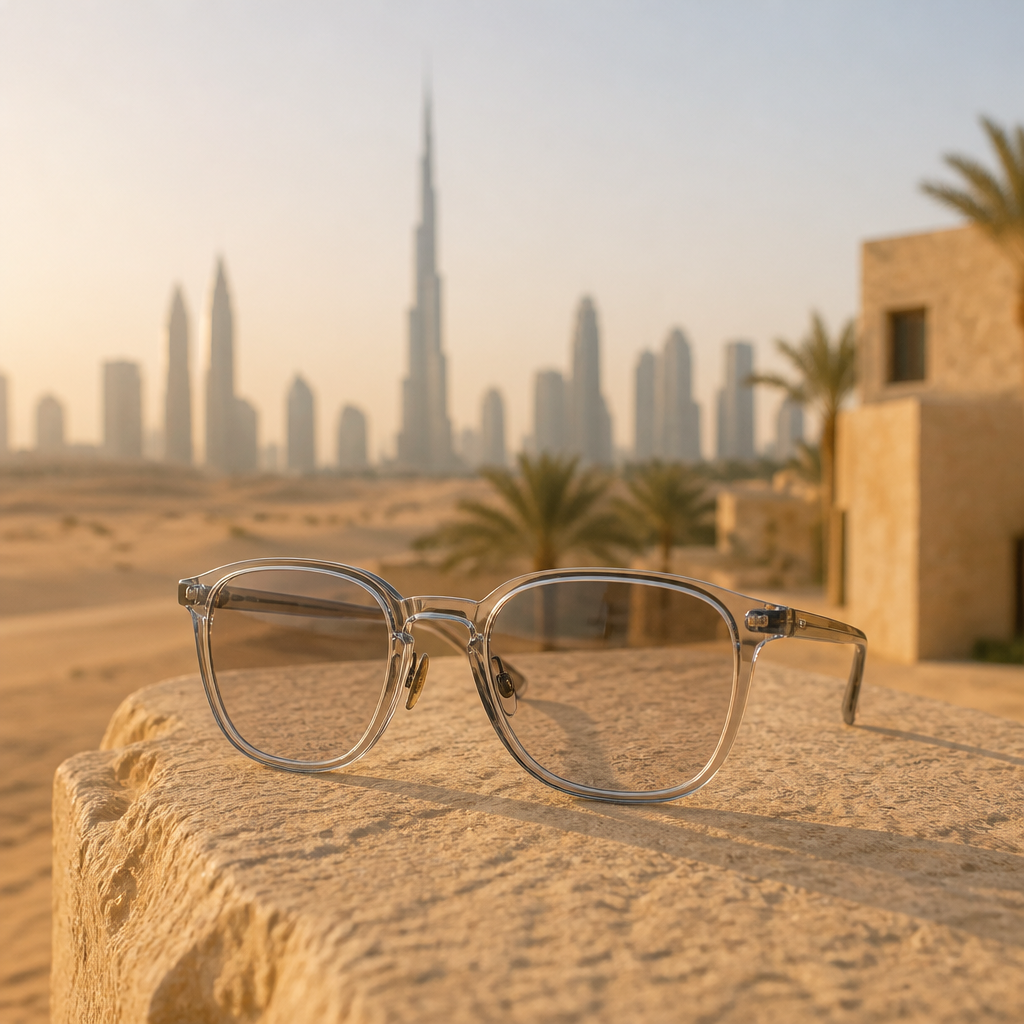
The important point for buyers is that the reaction depends mainly on UV exposure, not on how bright the scene looks to your eye. A bright white wall in the shade may look harsh, but it may not trigger much darkening. Direct sun at midday, on the other hand, will almost always push the lens to its darkest level available for that lens design.
Why the lens does not darken at the same speed every time
Activation and fading are both temperature dependent. Heat accelerates the molecular movement in both directions, so the lens clears faster when you walk back indoors, but it also struggles to reach the deepest tint. Cold does the opposite, which is why the same pair of glasses can behave very differently across seasons.
In practice, this means a lens you tested in a cool showroom may not show you its full performance in a Dubai August. Judge your lenses on the hottest day you actually plan to use them, not on the first day you wear them indoors.
What the darkening does not do
Darkening and UV protection are related but not identical. A lens can reach a dark shade while still needing a proper UV-blocking treatment, and a lightly tinted lens can still offer strong UV protection. Buy for protection first, then for the look and comfort of the tint.
Why Dubai Heat Changes the Equation
Dubai combines intense sunlight, long daylight hours and high ambient heat for much of the year. Those conditions push photochromic lenses in two directions at once. They activate quickly when you step outside, but in the hottest part of the day they often stop short of the dark, high-contrast tint that many wearers expect from a sunglass.
This is the most common complaint we hear from customers who wear transition lenses in the UAE for the first time. They report that the lenses change quickly in the car park but look only moderately dark on a beach at 2 pm. The reaction is working as designed, but the design was not built for the heaviest summer exposure.
Heat speeds activation and reduces depth
Published guidance on light-reactive lenses explains that in hot weather the molecules move faster, so the lens activates quickly but does not get as dark as it would in cooler conditions. That tradeoff is exactly what you notice on a Dubai summer afternoon. The lens reacts within moments, then settles at a shade that feels lighter than you wanted.
If your main concern is summer glare on the water, a lighter result may not be enough. For that use case, a dedicated tinted sunglass is usually the better tool, and a photochromic lens works better as your everyday pair for the transitions between shade and sun.
Glare on sand, water and pale buildings
The UAE has a lot of reflective surfaces, including sand, polished stone, glass towers and the water along the coast. Glare from these surfaces is more of a comfort and contrast problem than a pure brightness problem. Photochromic lenses reduce brightness, but they do not reduce reflected glare the way polarized lenses do, so you may still squint on a bright marina even when the tint looks right.
A lens that darkens well in the shop can still feel wrong on a Dubai beach. Judge it by how it handles glare and contrast, not just by how dark it gets.
Cool Months in the UAE
From about November to March, many wearers notice the opposite effect. The air is cooler, the sun is lower for much of the morning and afternoon, and the lenses reach a deeper shade and hold it for longer. That can be an advantage on a long walk or a golf round, but it can be frustrating when you enter a dimly lit office or a restaurant with warm lighting.
Research on winter performance of photochromic lenses explains that cold temperatures let the molecules stay in the darkened state longer, and winter conditions often include higher UV reflection from snow. Snow is not a factor in most of the UAE, so the reflection effect is smaller here, but the cold-related darkening can still be noticeable on a clear, cool morning.
Indoor comfort during the cooler season
A deep tint indoors can make offices, shops and homes look dim, and it can strain your eyes if you wear the lenses for hours. Some people switch to clear eyewear indoors, while others accept the shade. If you plan to wear the same pair all day, ask your optician whether a lens with a lighter activated shade is available for your frame.
The other practical point is that a lens that darkens strongly in winter may feel too dark for early evening driving or for walking in a dim souk. Test the lenses in the conditions you actually face, not only under bright store lights.
Why winter performance matters for buyers
Many buyers choose photochromic lenses in summer because that is when they feel the sun most. Their first winter with the lenses can be a surprise. Buying with the full year in mind helps you avoid a pair that is perfect in July and uncomfortable in January.
Transition Lenses Versus Dedicated Sunglasses
The question we get most often is whether transition lenses can replace a dedicated sunglass. The honest answer is that they can cover a lot of everyday use, but they are not a complete replacement in the UAE. The right choice depends on how much time you spend outdoors and what kind of light you face. The table below compares the three approaches we see most often.
| Approach | Best for | Main limitation in the UAE |
|---|---|---|
| Photochromic (transition) lenses in prescription eyeglasses | Everyday wear that moves between indoor and outdoor light, including commuting and short errands | Lighter shade in peak summer heat, and little darkening behind car windshields |
| Dedicated tinted sunglasses with a fixed shade | Beach days, long drives in full sun and anyone who wants a consistent dark tint all day | You must switch glasses when you go indoors, and a second pair adds cost |
| Polarized sunglasses, fixed or photochromic | Glare on water, sand and reflective roads, where contrast matters more than darkness | Polarized lenses may affect screen visibility on some devices, and photochromic polarized options cost more |
For most people, the best setup is a photochromic pair for daily use and a dedicated sunglass for summer glare. That combination costs more than one pair, but it covers the full range of conditions you meet across a Dubai year. If you only want one pair, choose a photochromic lens with strong UV protection and accept that it will be a little lighter at midday in July.
Driving and Indoor Use
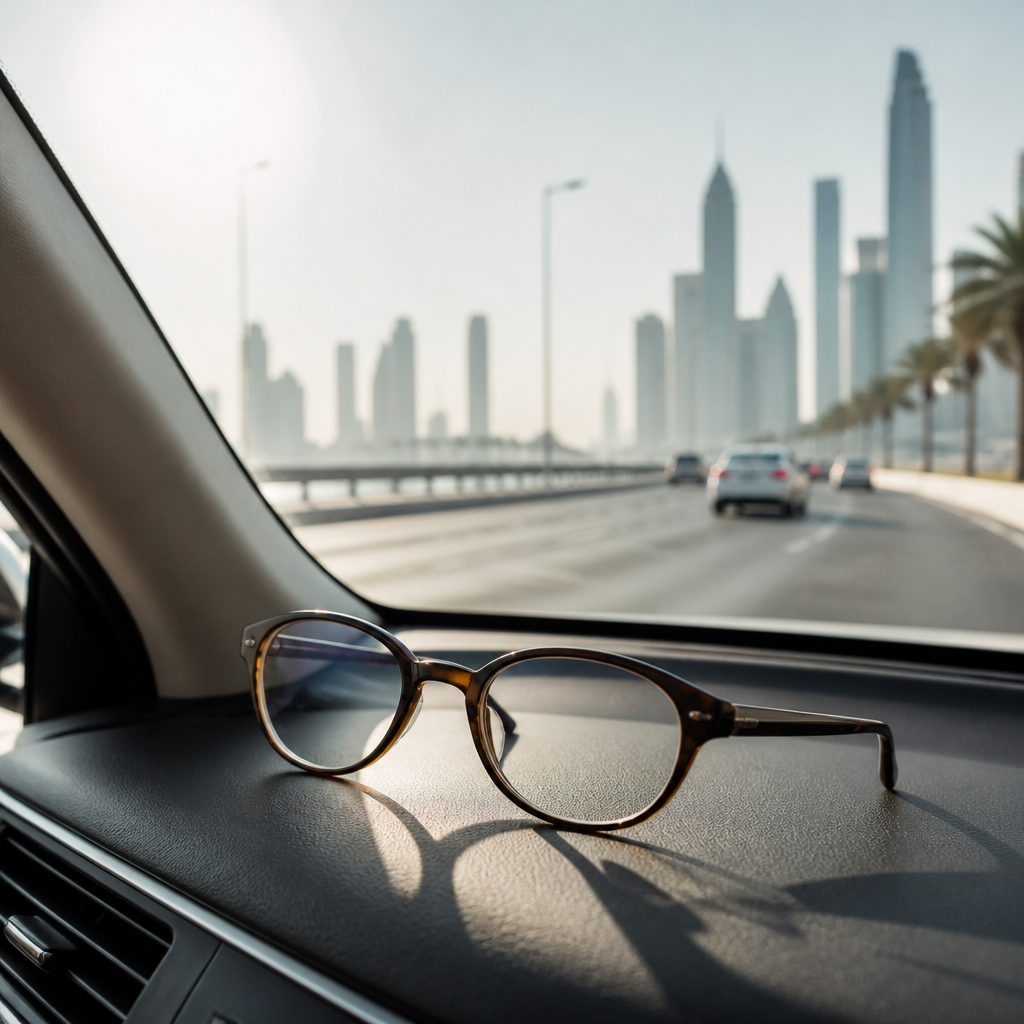
Driving is where photochromic lenses disappoint most often. Most windshields filter out much of the UV light that triggers the molecules, so the lenses stay clearer than you expect behind the glass. Side windows and rear windows behave differently, and the result is a lens that may look light while you drive but darken as soon as you step out.
That behavior is not a fault. It reflects the physics of the lens and the car glass. The practical solution is to keep a dedicated sunglass in the car, especially for long drives on the highway toward the north or east of the city where the sun can hit at a low angle through the windscreen.
Night driving and the dark-to-clear lag
When you move from bright sun into a dim parking structure, photochromic lenses take time to clear. Some wearers find this lag unsettling at night or in tunnels. If you drive a lot after dark, ask whether the lenses clear quickly in your chosen design and make sure you feel comfortable with them before you rely on them for night driving.
Screens and indoor work
Indoor work is usually fine with clear or lightly activated lenses, but a fully dark shade can make screen work uncomfortable. Many buyers in the UAE work in offices with bright lighting and large windows, which can keep the lenses partly active all day. That is a good reason to talk through the lens shade with your optician rather than accepting the default.
Choosing a Lens for Desert Sun
If you decide photochromic lenses suit your life, the next question is which version to buy. The choice of lens material, coating and activated shade matters as much as the brand name on the frame. A good pair for Dubai should block UV, clear reasonably fast, and remain comfortable at the shade you choose.
Start with the UV-blocking claim on the product information. Transition lenses from reputable brands are generally designed to block UVA and UVB, but you should still confirm this on the label or product page before you buy. Darkness is not a reliable proxy for protection, and a very dark lens without UV filtering is worse than a light one with proper protection.
Choosing the activated shade and color
Many photochromic lenses come in grey, brown and amber activated shades. Grey keeps colors closest to natural, which suits city wear and driving in mixed light. Brown and amber increase contrast, which helps on hazy days and on sand, though the exact effect depends on the lens. For Dubai, brown or grey is usually the safest starting point.
Ask for a sample or check the photochromic performance chart before you commit. A shade that looks right in a store under soft lighting may feel too pale in the open air.
Frames, fit and wraparound coverage
A lens that darkens well still needs to sit correctly. Gaps at the top and sides let bright light in from above and from the edges, which is where much of the glare on a Dubai beach comes from. A frame with a slightly deeper fit or a wraparound design can add real comfort on a bright day, even if the lens itself is the same.
Pro tip: Ask for the photochromic lenses to be fitted in a frame with a close, slightly curved front. Less light leaks around the edges, and the lens sees more consistent UV, which helps the shade settle more evenly.
Common Mistakes When Buying Transition Lenses
Most disappointing purchases come from a few avoidable mistakes. The first is judging the lens indoors. A lens tested under shop lighting will barely darken, and buyers often assume it will behave the same outdoors. Take a few minutes outside, ideally in direct sun, before you accept the pair.
The second mistake is expecting one pair to do everything. Photochromic lenses are excellent for changing light, but they are not a full replacement for a dedicated dark sunglass on a summer beach day. Set realistic expectations, and the lenses will feel much better in daily use.
Expecting full sunglass darkness from a light activated shade
Some buyers pick a lens with a pale activated shade to keep the look subtle, then find they squint at midday. If you want strong sun protection, choose a deeper activated option, or accept that you will also need a dedicated sunglass for peak sun.
Ignoring prescription and lens thickness
Prescription strength can affect how thick the lens is and how the photochromic layer sits in the frame. Higher prescriptions may need a different lens material, and the darkening may look slightly different across the lens. Confirm the lens index and prescription range with your optician before you order.
Pro tip: Before buying, ask the store to show you how the lens behaves after you step from the shop into direct daylight. Watch how long it takes to darken and how it looks when you step back inside. That short test tells you more than any product description.
Frequently Asked Questions
Do transition lenses get dark enough in Dubai summer?
They darken, but in peak summer heat they often settle at a lighter shade than you might expect from a dark sunglass. For midday beach or desert glare, a dedicated tinted sunglass usually gives stronger, more consistent protection.
Why do my photochromic lenses barely darken in the car?
Most windshields filter out much of the UV light that triggers the lens, so the molecules do not receive enough activation. Once you step outside the car, the lenses should darken again. Keep a separate sunglass in the car for driving in strong sun.
Are photochromic lenses good for winter in the UAE?
Yes, for many people. Cooler conditions let the lenses darken more deeply and hold the shade longer, which suits outdoor walks and golf. Indoors, however, a deep shade can feel dim, so consider a lighter activated option if you wear them for long periods inside.
Do photochromic lenses block UV rays?
Most modern transition lenses from reputable makers are designed to block UVA and UVB, but you should confirm this on the product information. Darkness alone does not tell you how much UV the lens blocks, so always check the stated protection.
Should I buy photochromic lenses or regular sunglasses for Dubai?
For most people, the answer is both. Photochromic lenses handle the everyday switch between indoor and outdoor light well. A dedicated sunglass is better for beach days, long drives and midday glare, and it costs less than frequent replacements of a lens that is not suited to your main use.
Have you worn transition lenses through a full Dubai summer, or did you find they fell short somewhere? Tell us which situation tested them most, and what you would change about your next pair.

