


Polarized vs Non-Polarized Sunglasses UAE Guide
Dubai sits under one of the most punishing sun environments on the planet. The UV index regularly hits 11, which the World Health Organization classifies as "extreme," and the city's glass towers, white sand beaches, and wide asphalt highways turn every outdoor moment into a glare battleground. If you are shopping for polarized sunglasses in the UAE and wondering whether that upgrade is actually worth it, the short answer is yes. But the longer answer matters, because there are specific situations where non-polarized lenses genuinely make more sense. This guide breaks down exactly what each lens type does, where each one excels in the Dubai context, and how to choose correctly the first time.
Table of Contents
- Quick Takeaways
- How Polarized Lenses Actually Work
- What Non-Polarized Lenses Do Well
- The Dubai Environment Case for Polarization
- When Polarized Lenses Fall Short
- Polarized vs. Non-Polarized: Full Comparison
- Choosing the Right Lens for Your Lifestyle
- How to Verify Your Lenses Are Genuinely Polarized
- Frequently Asked Questions
- References
Quick Takeaways
| Key Insight | Explanation |
|---|---|
| Polarized lenses block horizontal glare, not just brightness | They filter the specific light waves that bounce off flat surfaces like roads, water, and sand, which is exactly what creates blinding glare in Dubai. |
| Dark tint does not equal glare protection | A very dark non-polarized lens reduces overall light but still lets glare through. This is a common and expensive mistake when buying sunglasses in the UAE. |
| Dubai's UV index hits 11 (extreme) in summer | Both lens types must carry UV400 certification for eye safety. Polarization and UV protection are separate features, and you need both. |
| Polarized lenses create problems with LCD screens | Car dashboards, ATM screens, and smartphones can appear dark or washed out through polarized lenses, which matters when driving or navigating in the city. |
| Non-polarized lenses are better for pilots and cyclists on technical terrain | Any situation requiring precise reading of glossy or reflective displays favors non-polarized lenses, since glare cues can be useful for depth and surface judgment. |
| Premium brands like Ray-Ban and Prada offer both options | Polarized versions of the same frame typically cost more, but the optical difference is substantial enough to justify the price for daily outdoor use in the UAE. |
| Verify polarization before you buy | Hold the lens at a 90-degree angle in front of a phone or laptop screen. If the screen goes nearly dark, the lenses are genuinely polarized. If nothing changes, they are not. |
How Polarized Lenses Actually Work
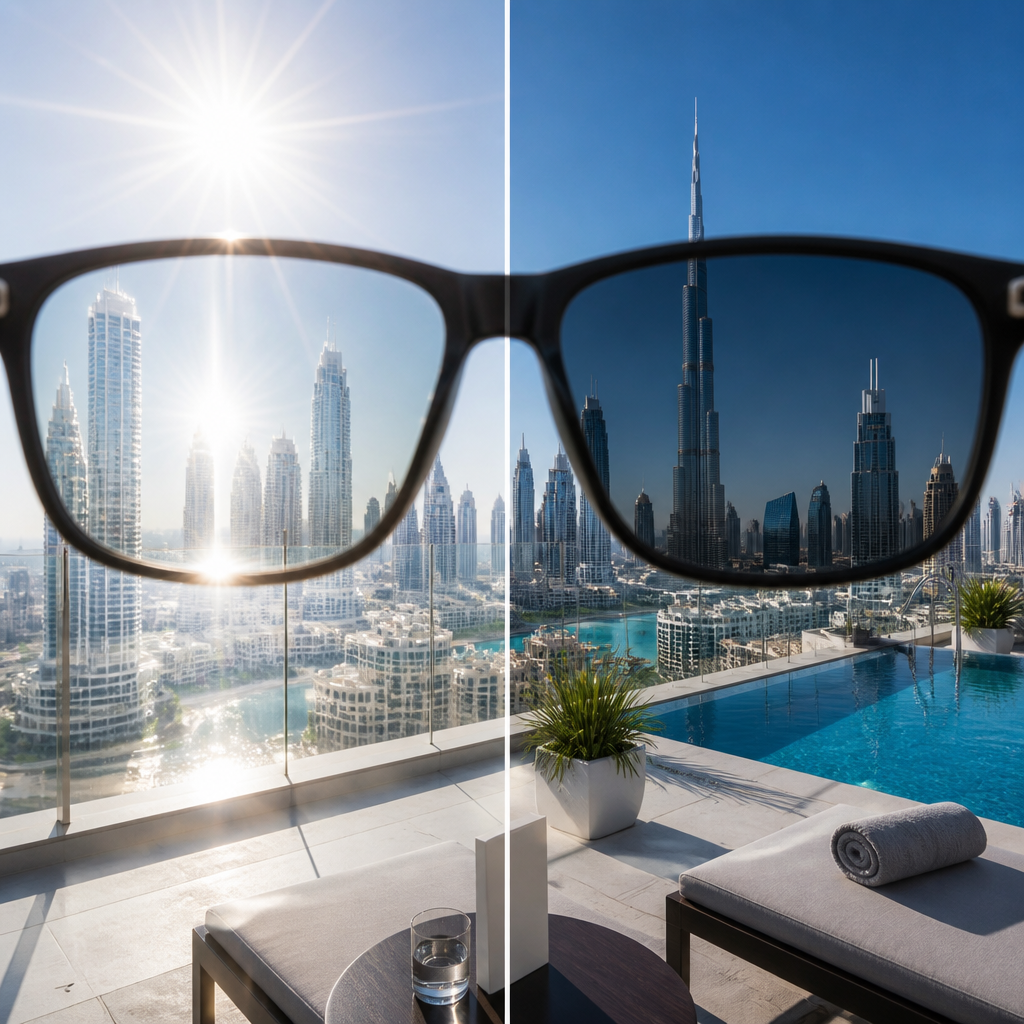
Light travels in waves that vibrate in multiple directions. When sunlight hits a flat horizontal surface, such as a road, a pool, or the desert sand, it reflects back predominantly as horizontal light waves. That concentrated horizontal bounce is what your eyes experience as blinding, uncomfortable glare.
Polarized lenses contain a chemical film oriented vertically. This film acts like a set of microscopic venetian blinds, allowing vertical light waves through while blocking horizontal ones. The result is not simply "dimmer" light. It is selectively filtered light, which means contrast improves, colors appear more accurate, and the visual fatigue from squinting against glare is largely eliminated.
Non-polarized lenses, regardless of how dark their tint, work differently. They apply a uniform dimming across all incoming light. That reduces overall brightness, which is still useful, but it does nothing to target the specific reflections that cause the most discomfort. The glare is still there. It is just slightly darker glare.
Pro tip: A lens can be very dark in color and still offer zero polarization. Always check for a polarization confirmation, not just lens shade, when buying sunglasses for outdoor UAE use.
What Non-Polarized Lenses Do Well
Non-polarized sunglasses are not a compromised product. They are a different tool with real use cases. For someone who primarily wears sunglasses indoors, in cars with tinted windows, or at events where reading a phone screen constantly, they are often the more practical choice.
Affordability and Accessibility
Non-polarized lenses are typically less expensive to manufacture, which is why most entry-level sunglasses use them. For buyers who want a stylish frame from a brand like Emporio Armani or Porsche Design primarily for fashion, non-polarized lenses deliver the look and the UV protection without the premium cost associated with polarized optics.
Compatibility with Digital Screens
LCD and LED screens emit light in a way that can interact badly with polarized filters. Non-polarized lenses let you read a car's digital dashboard, check a map on your phone, or use an ATM without the screen appearing washed out or nearly black. For city dwellers in Dubai who spend time moving between air-conditioned interiors and outdoor environments, non-polarized lenses often feel less disruptive.
Situations Requiring Glare as a Visual Cue
Pilots and cyclists navigating technical terrain often avoid polarized lenses deliberately. Certain types of glare, particularly on water or ice, provide useful information about surface conditions. Eliminating that glare entirely can reduce the contextual information available to the wearer. This is a narrow use case but worth knowing.
The Dubai Environment Case for Polarization
Dubai presents a combination of conditions that makes polarized lenses more useful here than in almost any other city. The sun angle, the surfaces, and the sheer number of hours spent outdoors or driving all point in one direction.
Reflective Road Surfaces and Highway Driving
Dubai's highways are wide, flat, and exposed. During summer months, the asphalt surface absorbs heat and reflects light intensely. Anyone driving on Sheikh Zayed Road or the Emirates Road during midday knows the shimmer that rises off the surface ahead. Polarized lenses cut through that road shimmer directly, converting a fatiguing visual experience into a clear, comfortable one. For residents who commute by car daily, this alone justifies the upgrade.
Beach and Marina Settings
Water is the most effective natural glare generator. Light reflecting off the Arabian Gulf or the pools at Jumeirah Beach creates exactly the kind of intense horizontal glare that polarized filters are designed to eliminate. Whether at the beach, on a boat, or sitting at an outdoor restaurant near the water, polarized lenses make the experience noticeably more comfortable and visually clear.
Desert Excursions and Sand Reflections
White and light-colored sand reflects sunlight in a way that is physically painful without proper protection. Dubai residents and visitors who take dune drives or desert camping trips outside the city face some of the highest glare intensity imaginable. In this setting, polarized lenses are not a luxury. They are a meaningful safety feature that reduces the risk of temporary vision impairment.
"Unlike ordinary tinted sunglasses, which reduce the brightness of all incoming light, the polarising filter selectively blocks the horizontally polarised reflections responsible for glare. In the UAE, where bright sunshine and reflective roads are common throughout much of the year, the difference is often immediately noticeable."
Glass-facade buildings in Downtown Dubai and Business Bay also contribute to urban glare, adding yet another polarized-light source that non-polarized lenses simply cannot address. The city is, architecturally and climatically, one of the strongest arguments for polarized eyewear that exists anywhere.
When Polarized Lenses Fall Short
Polarized lenses are not universally superior. There are specific situations in Dubai life where their characteristics become a genuine inconvenience.
Reading Touchscreens and Navigation Displays
The most common frustration polarized lens wearers report is difficulty reading phone screens and in-car navigation displays. The polarizing film interacts with the light modulation of LCD screens, making them appear very dark or distorted depending on viewing angle. If you drive with your phone mounted or rely on a digital dashboard display, this is a real issue worth planning around.
Night Driving
Any tinted lens, polarized or not, reduces the amount of light reaching the eye. At night, when available light is already low, wearing polarized sunglasses can make road conditions harder to read and reduce reaction time. This should be obvious, but it bears stating clearly: polarized lenses are a daytime tool only.
Overcast and Low-Light Conditions
During Dubai's occasional overcast days in winter, polarized lenses can reduce visual clarity by filtering out light that is not producing problematic glare. On those days, a lighter non-polarized lens often serves better. This is a minor consideration given how few cloudy days Dubai actually sees, but it matters for completeness.
Pro tip: If you need one pair that handles everything, choose a polarized lens with a medium-amber or brown tint rather than a very dark grey one. Amber and brown polarized lenses enhance contrast in mixed conditions, making them more versatile across Dubai's varied environments.
Polarized vs. Non-Polarized: Full Comparison
| Feature | Polarized Lenses | Non-Polarized Lenses |
|---|---|---|
| Glare reduction | Excellent. Blocks horizontal light waves directly responsible for glare from roads, water, sand, and glass. | Moderate. Reduces overall brightness but does not target the specific light waves that create glare. |
| Visual clarity outdoors | Superior. Colors appear more accurate, contrast is higher, and detail is sharper in bright sun. | Good. Comfortable in bright conditions, but glare remains a distraction on reflective surfaces. |
| Eye strain reduction | High. Significantly reduces the need to squint, especially during long drives or beach days. | Moderate. Reducing brightness helps, but remaining glare still causes fatigue over time. |
| LCD/LED screen compatibility | Poor. Screens may appear dark or distorted when viewed through polarized lenses at certain angles. | Excellent. No interference with digital displays, dashboards, or smartphones. |
| Night driving suitability | Unsuitable. Any tinted lens reduces available light at night; polarized makes this worse. | Also unsuitable for night driving, though clear or lightly tinted versions exist for dusk conditions. |
| Price point | Higher. The polarizing film adds to production cost. Premium brands like Ray-Ban and Prada charge a clear premium for polarized variants. | Lower. Available across all price ranges without the polarization markup. |
| Best use case in UAE | Daily driving, beach, desert trips, marina, outdoor dining, any activity with reflective surfaces. | Indoor-outdoor transitions, frequent screen reading, fashion-forward casual wear, overcast conditions. |
Choosing the Right Lens for Your Lifestyle
The polarized vs. non-polarized decision is not one-size-fits-all, but it is also not complicated once you know your primary use case. Here is how to map the choice to real Dubai lifestyles.
For Daily Commuters in Dubai
If you spend time driving in the UAE every day, polarized lenses are the clear winner. The road shimmer and glass-building reflections that hit drivers on every major road in Dubai are precisely what polarized filters eliminate. The LCD dashboard issue is real, but most people find they adapt their viewing angle quickly, or they use head-up display features that remain readable regardless.
For Beach and Outdoor Lifestyle Regulars
Anyone who spends meaningful time at JBR, Kite Beach, or out on the water does not need convincing after one afternoon in a polarized pair. The difference in comfort is so dramatic that returning to non-polarized lenses on the beach feels like a step backward. Look for Ray-Ban's polarized range or explore the broader polarized sunglasses collection for options suited to active outdoor wear.
For Fashion-First Buyers
If your primary goal is a frame that complements your look, and you wear sunglasses mostly indoors, in shopping malls, or at evening events, a non-polarized lens is a perfectly reasonable choice. Prada and Dior frames in their standard lens configurations deliver the aesthetic with UV protection intact. The visual performance difference will not be noticeable in those settings.
For Desert Adventure Seekers
Dune bashing, camel trekking, and overnight desert camps all involve exposure to extreme sand-surface glare. In these conditions, polarized lenses with a category 3 or category 4 tint provide both the glare filtering and the sheer brightness reduction the environment demands. A category 4 lens blocks the most light and is ideal for desert sun but should not be worn while driving.
How to Verify Your Lenses Are Genuinely Polarized
One of the most persistent problems in the UAE sunglasses market is the sale of non-polarized lenses marketed as polarized. Buying from an authorized retailer sourcing directly from manufacturers eliminates this risk entirely, but it is still useful to know the test.
Hold your sunglasses in front of any LCD screen (a smartphone, laptop, or ATM screen works perfectly) and slowly rotate the frame. If the lenses are genuinely polarized, the screen will appear significantly darker, approaching near-black, at roughly a 90-degree rotation. If the brightness of the screen does not change noticeably as you rotate the lens, the lenses are not polarized.
For Ray-Ban polarized lenses specifically, the letter "P" appears etched next to the Ray-Ban logo on the right lens of every authentic polarized pair. The absence of that "P" on a pair sold as polarized is an immediate authenticity red flag.
Beyond the test, UV protection must be confirmed separately. UV400 certification means the lens blocks all ultraviolet light up to 400 nanometres, covering both UVA and UVB rays. In Dubai, where the UV index reaches extreme levels for several months of the year, UV400 is non-negotiable regardless of whether you choose polarized or non-polarized lenses. Always verify the UV certification is printed inside the frame or on the original packaging, and never rely on the darkness of the tint as a proxy for UV protection. Those are two entirely separate features.
Frequently Asked Questions
Are polarized sunglasses worth the extra cost in Dubai?
For most people living or spending significant time outdoors in the UAE, yes. The combination of intense direct sunlight, reflective road surfaces, beach environments, and glass-covered buildings creates the exact conditions that polarized lenses are engineered to address. The visual comfort difference is immediately noticeable, and the reduction in eye strain over long drives or outdoor hours is meaningful for your long-term eye health. If your use is primarily indoor or fashion-focused, the premium is less justified.
Can I wear polarized sunglasses while driving in the UAE?
Yes, during daylight hours. Polarized lenses are particularly beneficial for daytime driving in the UAE because they cut the shimmer from hot roads and reduce reflections from surrounding vehicles and buildings. The one caveat is that some car dashboard displays and navigation screens can appear darker or distorted at certain angles through polarized lenses. This is a manageable adjustment for most drivers. Never wear any tinted sunglasses, polarized or not, while driving at night.
Do polarized lenses provide UV protection?
Polarization and UV protection are separate features. A polarized lens blocks glare-causing horizontal light waves. UV protection blocks ultraviolet radiation that causes eye damage. A well-made polarized lens will typically include UV400 protection, but this is not guaranteed by the polarization alone. Always verify that the lenses you are buying carry UV400 certification, especially if purchasing a brand you are unfamiliar with.
What is the best lens color for polarized sunglasses in the UAE?
Grey and brown are the most commonly recommended tint colors for UAE conditions. Grey polarized lenses reduce brightness without distorting colors, making them ideal for general outdoor use and driving. Brown and amber polarized lenses enhance contrast and perform particularly well in desert and sandy environments where depth perception matters. For water activities, brown or copper-tinted polarized lenses tend to give the most useful contrast enhancement.
How can I tell if my sunglasses are actually polarized and not just dark-tinted?
Hold one lens in front of any LCD or LED screen (your phone screen works perfectly) and rotate the glasses slowly. A genuinely polarized lens will cause the screen to darken significantly, approaching near-black, as you rotate to around 90 degrees. If the screen brightness does not change at all during rotation, the lenses are not polarized. For Ray-Ban specifically, look for the letter "P" etched next to the Ray-Ban logo on the right lens of authentic polarized pairs.
Are non-polarized designer sunglasses still worth buying in the UAE?
Absolutely. Non-polarized lenses in premium frames from brands like Prada, Dior, or Emporio Armani still deliver UV400 protection, quality optics, and the durability of authentic designer construction. If you wear sunglasses primarily at social events, in malls, or in low-glare environments, the polarized upgrade is genuinely unnecessary. The key is ensuring you still get UV400 certification, authentic sourcing, and quality lens coatings regardless of which type you choose.
Is there a risk of buying fake polarized sunglasses in the UAE?
Yes, this is a real concern. Counterfeit and mislabeled sunglasses sold as polarized when they are not are common in informal markets and some online channels. The only reliable protection is buying from retailers who source directly from the manufacturer and can verify authenticity. At Sunglass Hub, every product is sourced directly from brand manufacturers, which eliminates the counterfeit risk entirely and ensures that any lens sold as polarized has actually been verified to be so.
Have you switched from non-polarized to polarized lenses in Dubai? We would love to hear what difference you noticed in your daily routine.
References
- Gulf News: Why polarised sunglasses outperform ordinary tinted lenses for UAE conditions
- Polarized vs Non-Polarized Sunglasses: A UAE-specific comparison of benefits and limitations
- Healthline: How polarized lenses work, their advantages, and their documented drawbacks
- UV Index data and sun protection context for Dubai and UAE Emirates
- Detailed breakdown of polarized vs non-polarized lens performance across outdoor activities


