


Sunglass Frame Face Shape: The Complete Guide
Pick up any pair of sunglasses that looks great on a shelf, put them on your face, and they can look completely wrong. It happens constantly. The problem is almost never the frame itself. It is the mismatch between the frame shape and the wearer's face shape. Understanding the connection between sunglass frame face shape is the single most useful thing you can do before spending good money on designer eyewear, whether you are buying your first pair of Ray-Bans or adding a Prada frame to a growing collection. This guide will tell you exactly how to identify your face shape, which frames work and which do not, and how to apply those rules to real designer styles available at Sunglass Hub.
Table of Contents
- How to Identify Your Face Shape
- Quick Takeaways
- Best Sunglasses for an Oval Face
- Best Frames for a Round Face
- Best Frames for a Square Face
- Best Frames for a Heart-Shaped Face
- Best Frames for Diamond and Oblong Faces
- Frame Shape Comparison at a Glance
- Buying Designer Sunglasses in the UAE
- Frequently Asked Questions
- References
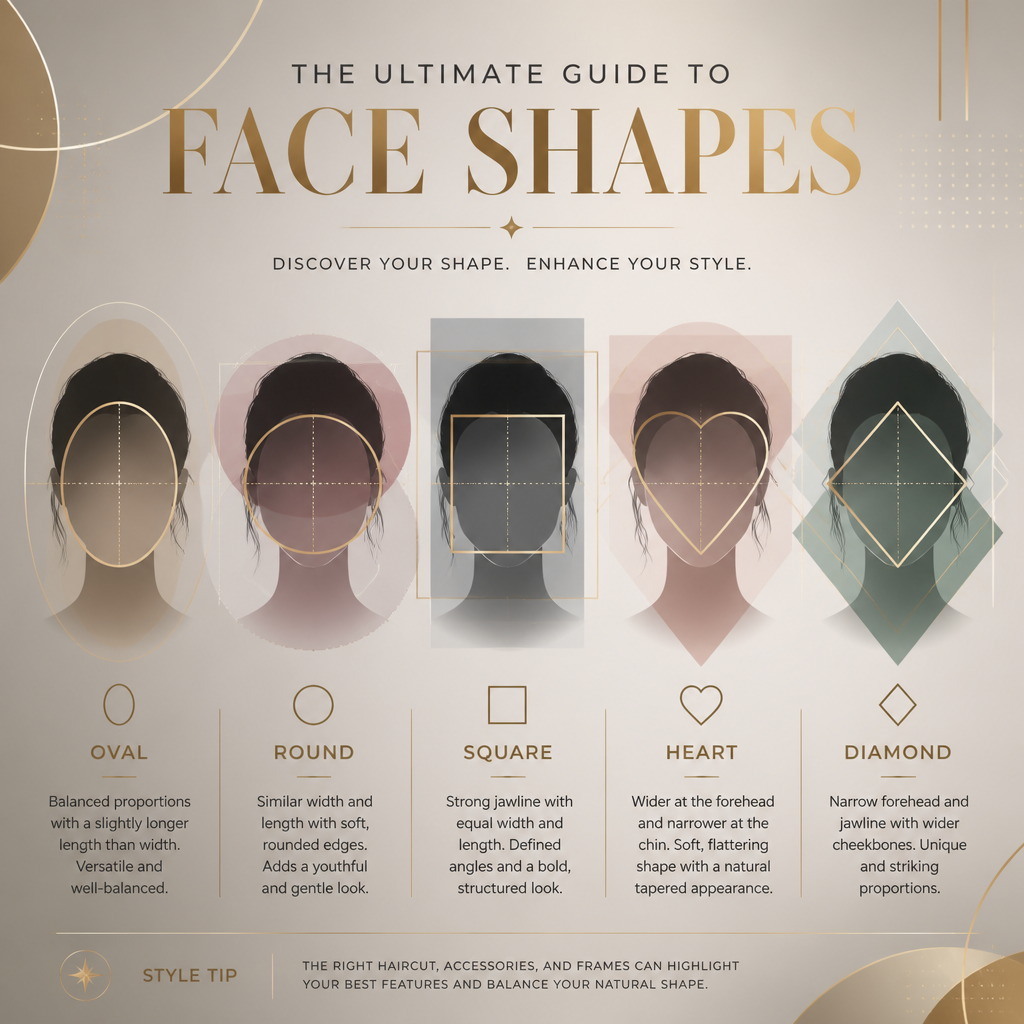
How to Identify Your Face Shape
Before any frame recommendation makes sense, you need an honest read on your face shape. The mirror-glance method gets you close, but measurements take guessing out of the equation entirely. You need four numbers: forehead width, cheekbone width, jawline width, and face length.
For forehead width, measure across the widest point of your forehead, roughly halfway between your eyebrows and your hairline. For cheekbone width, measure from the outer corner of one eye to the outer corner of the other, keeping the tape flat rather than curved against your skin. For jawline width, place the tape from the tip of your chin to just below your ear where the jaw angles upward, then double that number. For face length, run the tape from the center of your hairline straight down to your chin.
Once you have those four numbers, compare them to these patterns:
- Oval: Face length is noticeably greater than cheekbone width. Forehead is slightly wider than jawline. Cheekbones are the widest point.
- Round: Face length and cheekbone width are roughly equal. Forehead, cheekbones, and jawline are similar in width, with soft curves and a rounded chin.
- Square: Forehead, cheekbones, and jawline are all roughly equal in width. Jawline is strong and angular rather than rounded.
- Heart: Forehead is wider than the cheekbones and jawline. Chin is narrow and comes to a distinct point.
- Diamond: Cheekbones are the widest point. Forehead and jawline are both narrow, with the forehead narrower than the jaw.
- Oblong (rectangular): Face length is significantly greater than width. Forehead, cheekbones, and jawline are similar in width.
If you fall between two shapes, lean toward the one that captures your most prominent feature. Most people do not fit a single category perfectly, and that is fine. The goal is to identify which guidelines apply most closely, not to achieve geometric purity.
Pro tip: Pull your hair fully back before measuring or comparing. Even a small fringe or side parting can visually alter your forehead width and throw off an eyeball assessment.
Quick Takeaways
| Key Insight | Explanation |
|---|---|
| Oval faces are the most versatile | Almost every frame shape works on an oval face. The priority is choosing a frame width roughly equal to or slightly wider than the broadest part of the face. |
| Round faces need angular frames | Square or rectangular frames add definition and create the visual impression of a longer, more structured face. Avoid round frames, which amplify roundness. |
| Square faces benefit from curved frames | Oval, round, or cat-eye frames soften a strong jawline. The contrast between the curved frame and angular facial structure creates balance. |
| Heart faces work best with bottom-heavy frames | Frames that are wider or fuller at the base, such as aviators, draw visual weight downward and balance a wide forehead against a narrow chin. |
| Contrast is the core principle | In general, avoid frames that mirror your face shape. Round frames on round faces, or boxy frames on square faces, emphasize rather than balance your features. |
| Frame width matters as much as shape | A frame that is too narrow makes a wide face look wider. A frame that is too wide makes a narrow face look out of proportion. Match frame width to face width. |
| Guidelines are a starting point, not a rule book | Face shape recommendations point you toward a shortlist of flattering options. Personal style and comfort always have the final say. |
The contrast principle runs through every recommendation in this guide. Frames that oppose your natural contours create visual balance. Frames that repeat them amplify what is already there, which can work intentionally but rarely flatters by accident.
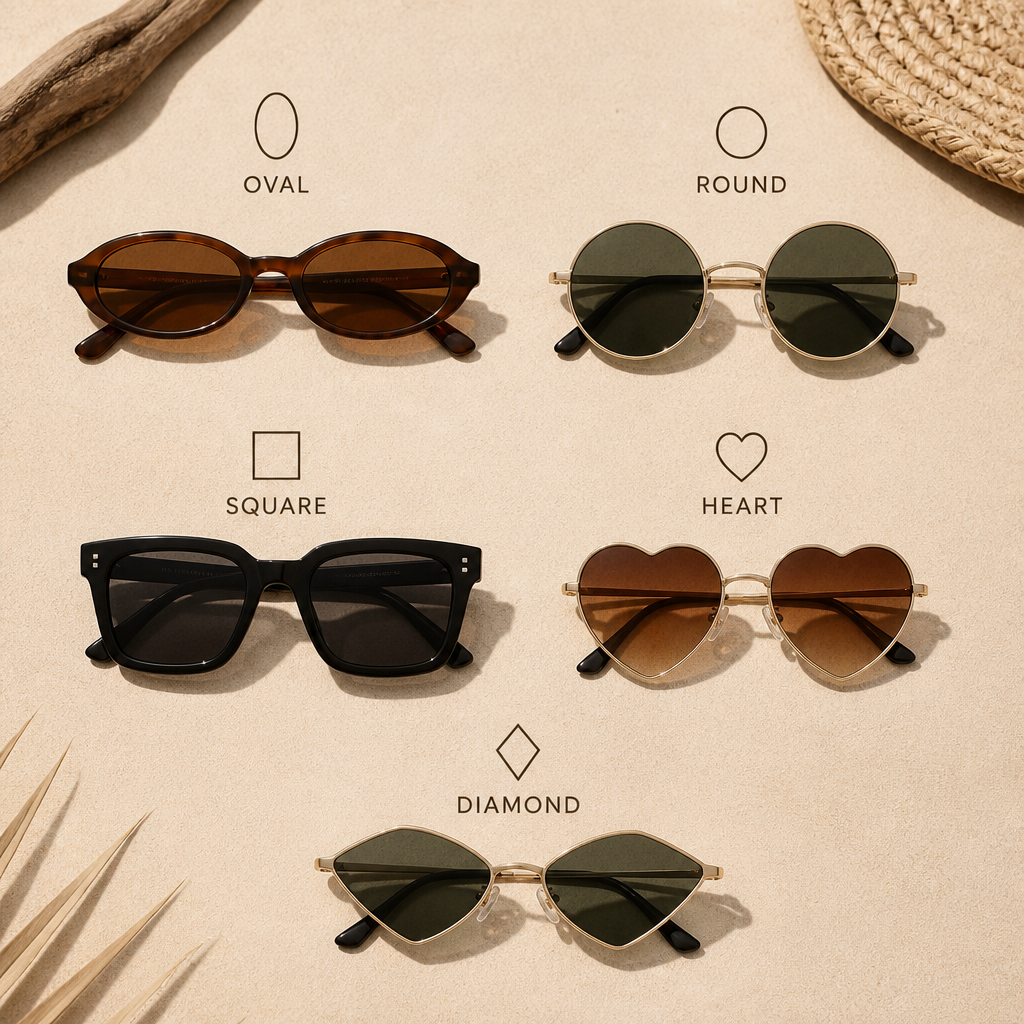
Best Sunglasses for an Oval Face
An oval face has higher, slightly wider cheekbones that taper gently toward both the forehead and the jaw. The face is noticeably longer than it is wide, with soft edges rather than sharp angles. This proportion is widely considered the most balanced face shape for eyewear, because it naturally suits the widest range of frame styles.
What works well
Square and rectangular frames are the most consistently recommended choice for oval faces. The straight edges and defined corners create a clear contrast against the face's curved features, adding structure and visual definition. Aviator frames also work extremely well: the gently curved top bar echoes the rounded forehead, while the widened lower lens adds visual weight below the cheekbones, reinforcing the face's natural balance. Geometric frames, oversized frames, and cat-eye shapes all sit comfortably on an oval face.
The one practical rule: keep frame width close to the widest part of your face. Frames significantly narrower than your cheekbones will look pinched, and frames dramatically wider will overwhelm the face's proportions. Within that sizing constraint, you have genuine freedom. At Sunglass Hub, the Ray-Ban collection offers everything from classic Wayfarers to geometric metal frames, all of which land well on oval faces.
What to avoid
Oversized round frames can elongate an already-long face further. Very narrow, rectangular frames can look out of scale if the face is long. These are not hard rules, but they are worth testing against your specific proportions before committing.
Pro tip: If you have an oval face and feel overwhelmed by too many options, start with a square or aviator shape. Both work on virtually every oval face regardless of skin tone or personal style, and both translate well into premium designer frames from brands like Prada and Dior.
Best Frames for a Round Face
A round face has similar face length and cheekbone width, with soft curves throughout and a rounded chin. The goal when choosing frames is to add definition and create the visual impression of length. Angular frames do this reliably.
What works well
Square and rectangular frames are the strongest performers for round faces. The sharp angles of these frames complement the softer lines of a round face, adding structure that the face's natural contours do not provide on their own. Browline frames, which concentrate visual weight along the top of the frame, also work well because they draw the eye horizontally and create the impression of width at the top without softening the overall look further.
The Emporio Armani collection at Sunglass Hub includes several strong rectangular and browline options that sit well on rounder face shapes.
What to avoid
Round frames on round faces are the clearest example of the repetition problem. They amplify the roundness rather than balancing it. Very small frames also tend to disappear on a round face, making it look larger by comparison.
The core principle of sunglass frame selection is contrast: shapes that oppose your natural facial geometry create balance, while shapes that repeat it simply amplify what is already there.
Best Frames for a Square Face
A square face has a strong, angular jawline and roughly equal forehead, cheekbone, and jawline widths. The goal with frames is to soften those angles rather than compete with them. Round and oval frames do this well; sharp geometric frames make the face look harder.
What works well
Oval frames are the most recommended choice for square faces because they introduce curved lines that directly contrast the face's angular structure. Round frames achieve the same effect. Cat-eye frames work well too, particularly styles with a gentle curve rather than an aggressive upswept angle. If you prefer a more streamlined look, thin metal frames in neutral tones reduce visual weight and soften the overall impression without going full circle. Aviators, which blend a straight brow bar with a rounded lower lens, are a strong middle ground for square-faced wearers who want something with more edge than a pure oval frame.
Browse the Porsche Design collection at Sunglass Hub for premium metal frames that sit especially well on angular faces, combining technical precision with shapes that avoid over-emphasizing a strong jaw.
What to avoid
Heavily rectangular or boxy frames emphasize a square jaw rather than softening it. Very angular geometric frames carry the same risk. The goal is to introduce contrast, not to double down on the structural elements already present.
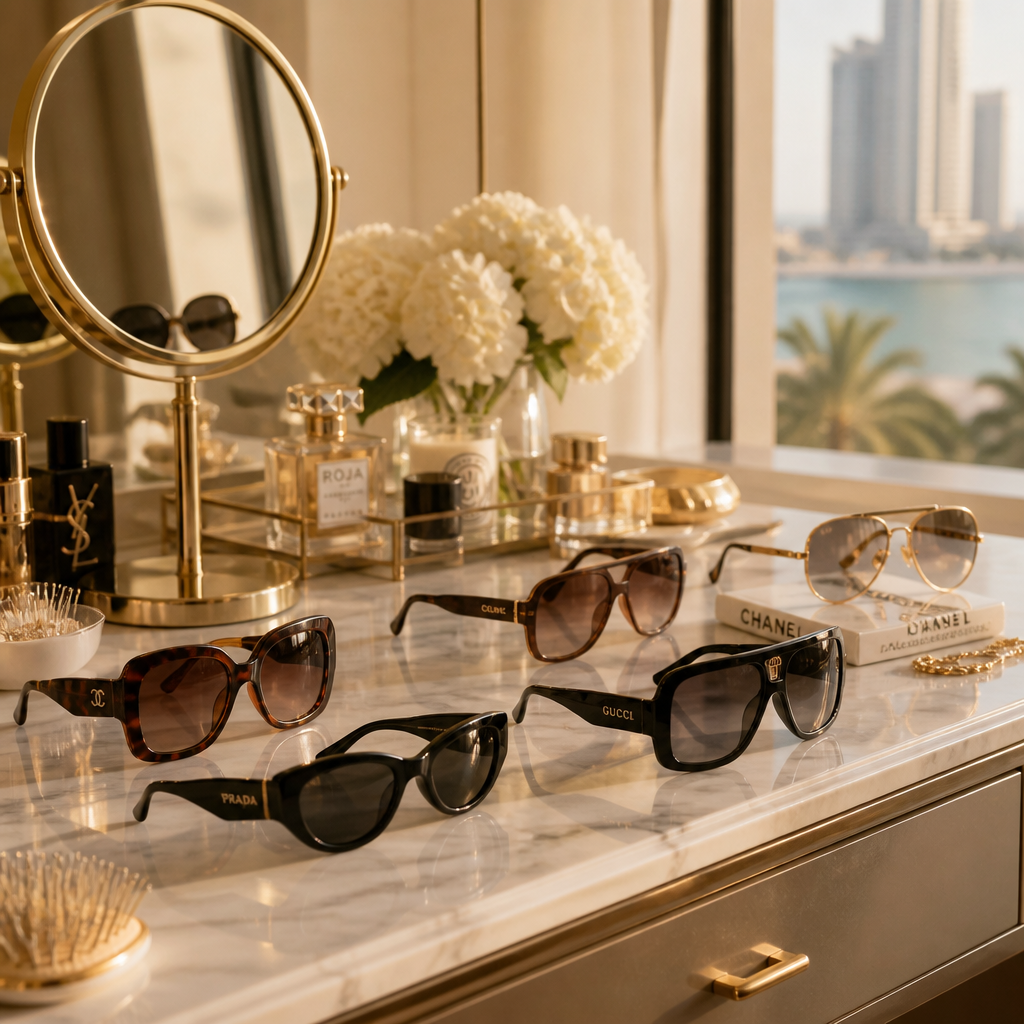
Best Frames for a Heart-Shaped Face
A heart-shaped face is widest at the forehead and narrows to a pointed chin. The challenge is balancing a prominent upper face against a narrow lower face. Frames that draw visual attention downward or add width at the bottom work best.
What works well
Aviator frames are a classic choice for heart-shaped faces. The teardrop shape is wider at the bottom lens than the top, which directly offsets the face's wider forehead by pulling visual weight downward. Round frames work well for the same reason: they are wider at the cheek level than at the top, which balances the forehead against the narrow jaw. Cat-eye frames, particularly those with a modest rather than extreme upsweep, add style without over-emphasizing the forehead. Rimless or low-bridge frames avoid adding visual bulk at the top of the face.
The Dior collection at Sunglass Hub includes several elegant cat-eye and soft-square styles that work well for heart-shaped faces, with the kind of refined detailing that suits the angular chin and prominent cheekbones of this face shape.
What to avoid
Heavy browline frames or heavily embellished top frames draw even more attention to an already-wide forehead. Very narrow frames look out of proportion when a face tapers strongly to a pointed chin. For heart-shaped faces, wide, top-heavy frames are the one category worth actively avoiding.
Best Frames for Diamond and Oblong Faces
Diamond and oblong faces are less commonly discussed but equally important to get right. They have different proportions and therefore different needs.
Diamond face
A diamond face is characterized by narrow forehead and jawline with wide, dramatic cheekbones. The cheekbones are the dominant feature, and the goal is to broaden the appearance of the forehead and jaw to balance them. Oval frames and cat-eye frames work well because they add visual width at the top and soften the prominence of the cheekbones. Rimless frames are another strong option: their lack of a defined outer line reduces the visual impact of the cheekbones without competing with them.
Oblong (rectangular) face
An oblong face is significantly longer than it is wide, with forehead, cheekbone, and jawline widths all close to each other. The goal is to add visual width and reduce perceived length. Oversized frames accomplish this well, as does anything with strong horizontal lines, such as wraparound styles and wide square frames. Avoid narrow, vertically oriented frames, which will make a long face look even longer. Decorative temple arms also help by drawing the eye to the sides of the face rather than along its vertical axis.
At Sunglass Hub, the Prada sunglasses collection includes several oversized and boldly proportioned frames that suit both diamond and oblong face shapes, with enough variety in lens shape and temple design to find a genuinely flattering option.
Frame Shape Comparison at a Glance
Use this table as a quick reference when you are shortlisting frames. It covers the three most common face shapes and maps them to practical frame choices and the styles worth avoiding.
| Face Shape | Best Frame Styles | Styles to Avoid |
|---|---|---|
| Oval | Square, rectangular, aviator, geometric, cat-eye, oversized | Frames significantly narrower than your cheekbones; extremely oversized round frames that elongate the face further |
| Round | Square, rectangular, browline, angular cat-eye | Round frames, very small frames, soft oval frames that repeat the roundness |
| Square | Oval, round, cat-eye, thin metal aviator | Heavily rectangular or boxy frames, sharp geometric frames that echo a strong jawline |
| Heart | Aviator, round, light cat-eye, rimless, low-bridge frames | Heavy browline frames, wide top-heavy frames, narrow frames that emphasize a pointed chin |
| Diamond | Oval, cat-eye, rimless, frames with detailed temples | Narrow rectangular frames, frameless styles that leave cheekbones visually dominant |
| Oblong | Oversized, wide square, wraparound, frames with decorative arms | Narrow vertical frames, small round frames that shrink horizontally |
Buying Designer Sunglasses in the UAE
Knowing your face shape is the foundation. Applying it to a purchase decision in the UAE context adds a few practical layers worth understanding. The sun in the UAE is intense year-round, which means lens quality matters as much as frame shape. A pair that flatters your face but offers inadequate UV protection is not a good pair. Look for 100% UV400 protection as a non-negotiable minimum, not a nice-to-have.
Authenticity and price
The UAE market for designer eyewear has a significant counterfeit problem at the lower end. A fake Ray-Ban or Prada frame may look passable in a photograph but will distort vision, crack at stress points, and provide no meaningful UV protection. Sunglass Hub sources directly from manufacturers, which eliminates the middlemen layers where substitution typically happens. Buying through an established, authenticated channel is not about brand loyalty; it is about ensuring the product actually does what it is supposed to do.
How to pick sunglasses in the UAE without a fitting room
Shopping online means you cannot always try frames on before committing. Use these practical filters when browsing. First, match frame width to your face width by checking the frame's listed lens width and bridge width measurements. Designer brands publish these consistently, and a reliable retailer will always list them. Second, apply your face shape guidelines to narrow the category before looking at individual styles. Third, use the Sunglass Hub 7-day return policy as a safety net: if a frame does not sit right when it arrives, return it. Fitting is iterative, and one exchange is far less costly than keeping a pair that never looks quite right.
Pro tip: When ordering online, compare the frame width measurement to the widest point of your face. Most adults have a face width between 130mm and 145mm. A frame listed at 140mm total width will sit close to flush on a 138mm face, which is the target. Frames more than 10mm wider than your face will look oversized; frames more than 10mm narrower will look pinched.
Frame materials in a hot climate
UAE temperatures place specific demands on frame materials. Acetate frames are durable and hold their shape well in heat, but cheaper acetate warps in sustained direct sunlight when left in a car. Metal frames conduct heat and can become uncomfortable on the skin after extended outdoor wear. Premium acetate from established brands is a better everyday choice for the region. Titanium frames, found in several Porsche Design and higher-end Dior styles, are lightweight, heat-stable, and corrosion-resistant, making them a practical choice for the coastal humidity of Dubai and Abu Dhabi.
Frequently Asked Questions
What is the best way to figure out my face shape without a measuring tape?
Stand in front of a well-lit mirror and pull all your hair back. Look at the overall outline of your face: is it widest at the forehead, cheekbones, or jaw? Is the overall shape longer than it is wide, or roughly equal? Then focus on the jawline: is it soft and rounded, wide and flat, or pointed? These three observations, widest point, length-to-width ratio, and jaw shape, will get you to the right category in most cases. A measuring tape adds precision, but it is not required for a useful starting point.
Can I wear any frame shape if my face is oval?
Practically, yes. Oval faces are the most versatile shape for eyewear because the naturally balanced proportions do not impose restrictions. Almost every frame style works, from classic round frames to bold geometric shapes to oversized square frames. The main sizing consideration is that frame width should be close to the widest point of your face, but within that constraint, you have more freedom than any other face shape.
Are aviator sunglasses good for all face shapes?
Aviators work well on most face shapes but are especially flattering on oval and heart-shaped faces. On oval faces, the teardrop proportions mirror the face's natural balance. On heart-shaped faces, the wider lower lens draws visual weight downward, offsetting a wide forehead. On round faces, aviators are a reasonable but not ideal choice because the curved lower lens can amplify roundness slightly. On square faces, aviators are a useful middle ground when a full oval or round frame feels too soft.
How do I know if a frame is the right size for my face?
The frame width should be roughly equal to the widest point of your face, with a tolerance of about 5-10mm either side. When worn, the frame should not extend beyond the temples, and the lenses should not sit so close to your cheeks that they touch when you smile. Designer frames list their measurements as lens width, bridge width, and temple length. Adding the lens width of both lenses plus the bridge width gives you the total frame width, which you can compare to your own face measurement.
Is it worth paying more for designer sunglasses over generic frames in the UAE?
For everyday wear in a high-sun environment, yes. Certified designer frames from brands like Ray-Ban, Prada, and Dior include tested UV400 lens coatings, optically correct lenses that do not distort vision, and frame materials that hold their shape over time. Generic frames often lack consistent lens optical quality, which matters when you wear them for hours at a time. The health case for authentic designer lenses is separate from the style case, but both point in the same direction.
Does face shape advice apply differently for men and women?
The underlying geometry is the same for both. Oval faces benefit from square frames, round faces from angular frames, and so on, regardless of gender. What differs is the frame catalog available within each shape category. Men's lines tend toward thicker acetate, prominent bridge hardware, and square proportions, while women's lines include more cat-eye options and finer metalwork. But many contemporary designer frames are deliberately unisex in proportion, and the face shape rules apply to all of them equally.
If you have found a frame that works for your face shape or want to share what has surprised you in the UAE's heat, leave a comment below. Experience from real wearers helps everyone make a better decision at the counter.
References
- Face shape guide explaining oval, round, square, heart, and diamond face types with frame recommendations
- How to measure your face and match your face shape to a sunglass frame style
- Step-by-step guide to measuring forehead, cheekbone, jawline, and face length for eyewear selection
- Sunglass frame recommendations specifically for heart-shaped faces
- A guide to finding the right sunglass shape for every face type using measurements and visual cues


