


UV Protection Sunglasses UAE: The Dubai Buyer's Guide
Most people in Dubai choose sunglasses for style first and protection second. That is a reasonable instinct until you understand what the UAE sun is actually doing to unprotected eyes. Dubai and the wider Gulf region sit between 22° and 30° North latitude, close enough to the equator that UV radiation stays intense year-round, not just in the peak summer months. Add desert sand that reflects UV rays back upward, consistently cloudless skies, and daily outdoor commutes, and you have one of the most demanding environments on earth for UV protection sunglasses in the UAE. This guide breaks down exactly what the labels mean, which lens features actually matter, and how to shop for authentic eyewear that delivers real protection rather than a dark tint and false confidence.
Table of Contents
- Quick Takeaways
- Why Dubai UV Exposure Is Different From Anywhere Else
- Decoding UV Protection Labels: UV400, CE, and What They Actually Mean
- Polarized vs. UV Protection: Two Different Things You Need to Stop Confusing
- The Lens Tint Darkness Myth That Is Damaging UAE Eyes
- Lens Filter Categories: Which Category Is Right for Dubai?
- Frame Style and Coverage: Why Wraparounds Win in the Desert
- Authentic vs. Counterfeit Sunglasses: The UV Protection Gap
- Best Brands for UV Protection Sunglasses in the UAE
- UV Protection: Comparing Your Options at a Glance
- Frequently Asked Questions
- References
Quick Takeaways
| Key Insight | Explanation |
|---|---|
| UV400 is the minimum standard in the UAE | UV400-rated lenses block all UV light up to 400 nanometres, covering both UVA and UVB. Anything below this standard is inadequate for Dubai's daily sun levels. |
| Dark tint does not equal UV protection | Lens darkness controls brightness, not UV. Dark lenses without a UV400 rating cause pupils to dilate, actually increasing UV exposure to the retina. |
| Polarized lenses reduce glare, not UV rays | Polarization filters horizontal light from reflective surfaces like roads and water. It improves visual comfort but adds zero extra UV protection on its own. |
| The UAE's UV index stays high year-round | Unlike European climates, the Gulf region maintains consistently high UV index values across all seasons. Winter mornings in Dubai can still exceed the WHO's recommended protection threshold of index 3. |
| Frame coverage matters as much as lens rating | Wraparound frames block UV from entering around the sides of the lens, reducing peripheral UV exposure that standard frames allow through. |
| Counterfeit sunglasses carry real health risk | Fake designer eyewear often uses untreated plastic lenses with a dark tint and no UV filter. The wearer gets the pupil-dilating effect with none of the protection. |
| Children need UV protection more urgently than adults | Children's eyes have clearer lenses that allow more UV radiation to reach the retina. Research indicates children can receive around three times more annual UV exposure than adults. |
Why Dubai UV Exposure Is Different From Anywhere Else
The UAE's geographic position changes the entire conversation about eye protection. The Gulf region sits significantly closer to the equator than most of Europe or North America, which means UV radiation arrives at a steeper angle and with less atmospheric filtering. Dubai and Doha face high year-round UV levels compounded by desert reflectivity and near-cloudless skies, a combination that has no equivalent in most temperate countries.
Desert sand reflects roughly 25% of UV radiation back upward, meaning your eyes catch UV from above and below simultaneously. On the road, glare from flat, sun-baked asphalt adds a second reflective source. This double-exposure effect is why eye specialists in the region consistently see conditions such as pterygium (a tissue growth across the cornea triggered by chronic UV and wind exposure) at higher rates than in cooler climates.
Many residents in the UAE assume that hazy or dusty days reduce UV risk. That assumption is wrong. UV rays penetrate cloud cover and atmospheric haze at levels that still cause eye damage. The World Health Organization recommends sun protection measures whenever the UV index reaches 3 or above. In Dubai, that threshold is crossed most days of the year, with the strongest UV months running from April through October and peak intensity hitting between 10 am and 2 pm local time.
UV radiation in the Gulf region remains intense enough to cause cumulative eye damage year-round. Seasonal thinking about sun protection is a habit imported from climates that do not apply here.
The health consequences of chronic UV overexposure to the eyes are well-documented. Cataracts, the leading cause of blindness worldwide, are linked to UV exposure, with global health estimates suggesting at least 20% of cataracts are attributable to excess UV. Photokeratitis (essentially a corneal sunburn) causes acute pain and temporary vision loss. Macular degeneration damages the central retina over time. None of these conditions announce themselves while they are developing, which is exactly why protective habits matter before symptoms appear.

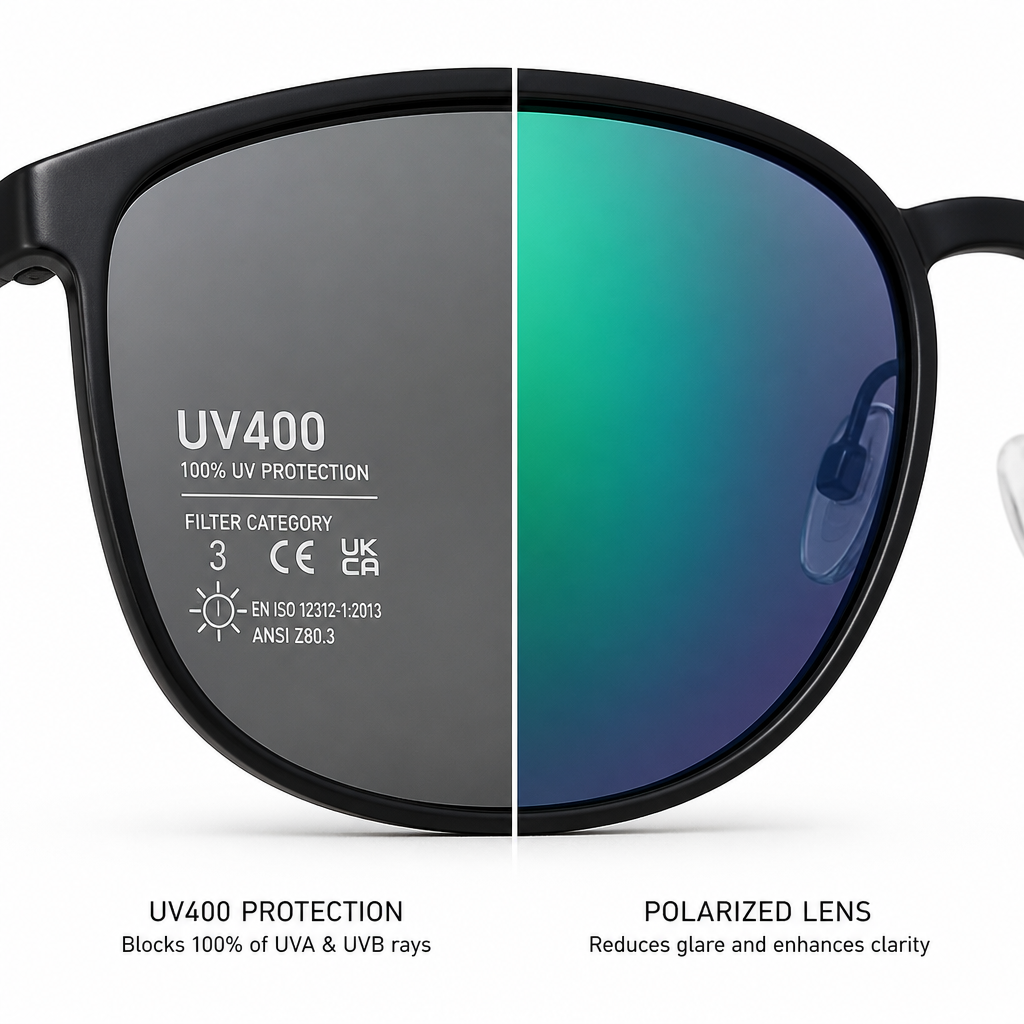
Decoding UV Protection Labels: UV400, CE, and What They Actually Mean
The label printed on a sunglass lens or hang tag is not decoration. It is a specification, and reading it correctly is the most important practical skill a sunglass shopper in the UAE can have.
UV400: The Rating That Actually Counts
UV400 means the lenses block all ultraviolet light with a wavelength up to 400 nanometres. This covers the full UVA spectrum (315 to 400nm) and the full UVB spectrum (280 to 315nm). Any lens with this rating provides complete UV protection regardless of its price point or brand. No additional UV-specific coating is necessary if the UV400 marking is genuine and verified.
UV400 actually exceeds the baseline required by European CE marking standards, which cover UV protection up to 380nm. When you see both UV400 and CE on a frame, you are looking at a lens that meets the stricter standard. The relevant standard reference is BS EN ISO 12312-1, which governs sunglass safety in both the UK and European markets and is widely referenced by legitimate eyewear brands sold in the Middle East.
What the CE Mark Tells You
The CE mark indicates the eyewear has been tested to meet European safety standards for optical quality, UV filtration, and mechanical durability. For Dubai shoppers buying from reputable retailers, CE-marked eyewear from established brands provides a reliable baseline guarantee. The mark should appear on the frame itself, not just on packaging that can be swapped or faked.
Pro tip: When buying sunglasses in the UAE, check that the UV400 or CE marking appears on the frame or directly on the lens, not only on a removable sticker or box. A sticker proves nothing about the actual lens.
Polarized vs. UV Protection: Two Different Things You Need to Stop Confusing
This is the single most common misconception in sunglass shopping across the UAE, and it is worth being direct about it. Polarization and UV protection are completely separate technologies that do completely separate jobs.
UV protection is a chemical property of the lens material or coating that absorbs or blocks UV radiation. You cannot see it working and it does not affect how bright or dark things look. Polarization is a physical filter layered into the lens that blocks horizontally reflected light, the kind that bounces off flat surfaces like roads, car bonnets, and water. This eliminates glare and makes colours appear more vivid and accurate.
In the UAE context, polarized lenses are genuinely valuable for driving and outdoor activities because they cut the flat-road glare that causes squinting and eye fatigue. A polarized lens that also carries a UV400 rating gives you both benefits simultaneously. But a polarized lens without UV400 certification is not protecting your eyes from radiation. And a UV400 lens without polarization is protecting against UV but not reducing glare.
The practical advice is simple: for the UAE, choose sunglasses that are both UV400-rated and polarized. Most quality frames from established brands offer this combination. Do not assume that one implies the other.
Pro tip: To test whether a lens is truly polarized in-store, hold the lens at a 90-degree angle to another polarized surface (many phone screens work well). The lens will visibly darken if it is genuinely polarized. This test does not verify UV protection, but it confirms the polarization claim is real.
The Lens Tint Darkness Myth That Is Damaging UAE Eyes
Across Dubai's markets, a dangerously common assumption persists: the darker the lens, the better the protection. This is wrong, and the consequences of getting it wrong are serious.
Lens darkness controls light transmission, which affects brightness and comfort. It has no bearing on UV filtration whatsoever. When you wear dark lenses without a UV400 coating, your pupils dilate to compensate for the reduced visible light. Those dilated pupils then allow more UV radiation through to the retina than they would in bare sunlight, where your natural squinting response would partially shield your eyes. A dark, unprotected lens is actively worse than no lens at all.
This is not a hypothetical edge case. Counterfeit and low-quality sunglasses sold across the UAE frequently use dark tinting without any meaningful UV filter. The wearer feels protected, their eyes feel comfortable from the reduced brightness, and meanwhile their unshielded retina absorbs more UV radiation per minute than it would without sunglasses.
The lesson: do not buy sunglasses based on how dark the lens looks. Buy them based on what the UV400 label says, verified from a trustworthy source.
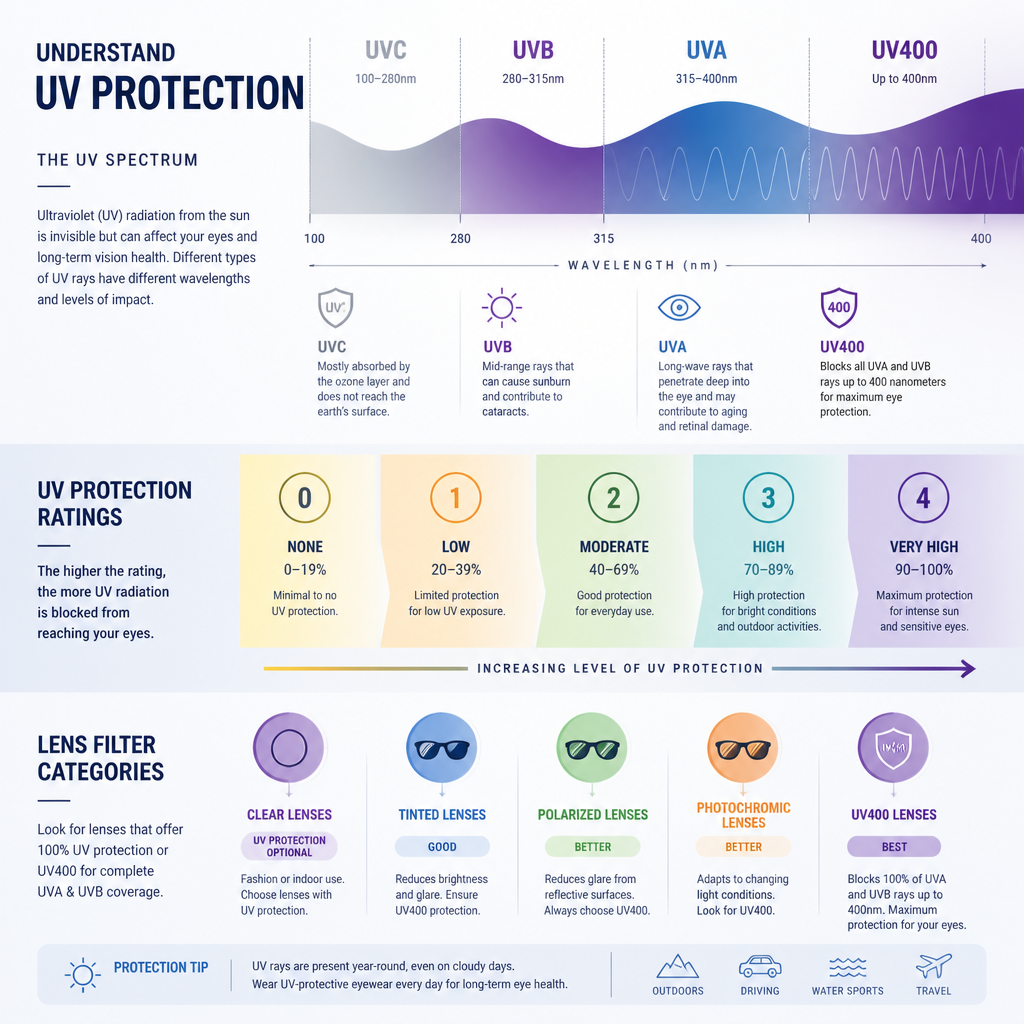
Lens Filter Categories: Which Category Is Right for Dubai?
Sunglass lenses are classified into five categories (0 through 4) based on how much visible light they transmit. Understanding these categories helps UAE shoppers choose the right lens for different activities.
- Category 0: Fashion lenses with very little tint. Not suitable as sun protection in the UAE.
- Category 1: Light tint for overcast conditions. Still not adequate for Dubai's typical outdoor environment.
- Category 2: Medium tint, suitable for occasional sun. Acceptable for shaded outdoor environments or indoor use near bright windows.
- Category 3: The standard for sunglasses in sunny climates. Blocks 82 to 92% of visible light. This is the category recommended for everyday UAE outdoor use, including driving.
- Category 4: Very dark lenses for extreme sun environments such as high-altitude snowfields. Not legal for driving in most jurisdictions and excessive for street use in Dubai.
For daily life in Dubai, whether commuting, spending time on the beach, or walking between air-conditioned buildings, Category 3 lenses with UV400 certification are the right choice. Category 3 provides enough darkness to handle the UAE's bright daylight without over-darkening to the point of reduced situational awareness.
Frame Style and Coverage: Why Wraparounds Win in the Desert
The lens rating matters. So does the frame design around it. A UV400 lens set in a small or widely-open frame still allows UV radiation to reach the eye from the sides and above, particularly when the sun is at a lower angle or when you are moving through bright reflected environments.
Wraparound frames address this by extending lens coverage around the temporal area of the face, blocking UV from peripheral angles. Research has confirmed that frame style plays a meaningful role in the total amount of UV reaching the eye, with wraparounds offering measurably better coverage than standard flat frames.
For UAE conditions specifically, two additional frame considerations matter. First, the nose bridge fit affects whether light enters from below. A frame that sits too far from the face leaves a gap where reflected ground UV can enter. Second, wide-temple frames offer some side shielding even without full wraparound geometry. Ray-Ban's Aviator and Wayfarer styles, for instance, offer substantial lens coverage even without wraparound geometry, making them practical for everyday wear while maintaining their classic silhouette.
Oversized frames in the Prada or Dior tradition are not just a fashion statement in the Middle East. Their generous lens area physically covers more of the orbital region of the face, reducing the amount of UV that reaches the eye through the top and sides of the frame. Function and aesthetics converge more than most shoppers realize.
Authentic vs. Counterfeit Sunglasses: The UV Protection Gap
The UAE has long been a market where counterfeit goods circulate alongside genuine products. For clothing or accessories, a fake is a financial and ethical problem. For sunglasses, it is also a health problem.
Counterfeit sunglasses are made with untreated plastic lenses that carry a dark tint but no UV filter. They mimic the appearance of premium eyewear without any of the optical engineering. The UV400 label, if present on a counterfeit pair, is printed or stickered on without any corresponding lens treatment. There is no functional test a consumer can perform on the street to distinguish a UV400 coating from a fake label.
The only reliable protection against counterfeit eyewear is the supply chain. Authentic designer sunglasses sourced directly from manufacturers or authorized distributors carry the genuine lens treatment that the UV400 label represents. This is why provenance matters when shopping for best UV sunglasses in Dubai. A pair of Ray-Bans bought from a grey-market reseller at a discount may be authentic or may be a very convincing fake. A pair bought from an authorized retailer sourcing directly from the manufacturer is unambiguously genuine.
At Sunglass Hub, every frame is sourced directly from brand manufacturers, which eliminates the grey-market uncertainty entirely. The price difference between authentic and counterfeit is real, but it reflects the difference between actual UV protection and a cosmetic approximation of it. For something that protects your eyesight over decades, that gap is not negotiable.
Best Brands for UV Protection Sunglasses in the UAE
All the major designer brands available through Sunglass Hub meet the UV400 standard as a baseline. The differences between them lie in lens technology, frame engineering, and lifestyle fit, not in the fundamental UV protection rating.
Ray-Ban
Ray-Ban's standard G-15 glass lens and its polycarbonate alternatives all carry UV400 certification. The brand's Polarized collection adds glare elimination on top of UV blocking, making models like the Aviator Polarized and Wayfarer Polarized particularly practical for UAE driving conditions. Ray-Ban is the most consistently popular choice for everyday sun protection eyewear in the region for good reason: the optical quality is consistent, the fit range is wide, and the authentic-versus-fake distinction is well-established.
Prada and Dior
Both brands produce oversized and geometric frames that combine extensive facial coverage with UV400 lenses. Prada's Linea Rossa sport line adds lightweight frame engineering suited to the UAE's outdoor lifestyle. Dior's gradient lens options are popular in the region. It is worth noting that gradient lenses darken from top to bottom, which means the lower portion of the lens transmits more light. UV400 protection applies uniformly across the entire lens regardless of gradient, so the protection is consistent even where the tint appears lighter.
Porsche Design and Emporio Armani
Porsche Design frames are engineered for driving performance, with polarized UV400 lenses and wraparound geometry that suits UAE highway conditions particularly well. Emporio Armani offers a lighter aesthetic, with slim metal frames and UV400 lenses that work well for professional and social environments where sport-style wraparounds would feel out of place.
UV Protection: Comparing Your Options at a Glance
| Feature | UV400 Only | UV400 + Polarized | UV400 + Polarized + Wraparound Frame |
|---|---|---|---|
| Blocks UVA and UVB rays | Yes | Yes | Yes |
| Reduces road and water glare | No | Yes | Yes |
| Blocks peripheral UV entry | No | No | Yes |
| Suitable for UAE driving | Adequate | Recommended | Best option |
| Suitable for beach and desert outdoor use | Adequate | Recommended | Best option |
| Ideal for urban professional environments | Yes | Yes | Depends on frame style |
| Available from premium brands at Sunglass Hub | Yes | Yes | Yes (Porsche Design, Ray-Ban sport) |
Frequently Asked Questions
What does UV400 mean on sunglasses sold in the UAE?
UV400 means the lenses block all ultraviolet radiation with wavelengths up to 400 nanometres, covering the full UVA and UVB spectrum. It is the internationally recognized standard for complete UV protection and the minimum rating recommended for outdoor use in the UAE's high-UV environment. Any sunglass sold without this rating provides incomplete protection regardless of how dark or expensive it looks.
Do I need UV protection sunglasses in Dubai all year, not just in summer?
Yes. The Gulf region's geographic position means UV index levels remain high across all seasons, unlike temperate climates where winter brings a genuine reduction in UV intensity. The UAE's consistently clear skies mean there is very little cloud filtering even in winter months. The WHO recommends sun protection above a UV index of 3, a threshold Dubai exceeds on most days of the year. Year-round daily wear is not overcaution in the UAE. It is the medically appropriate response to the actual environment.
Are polarized sunglasses better for UV protection than non-polarized ones?
No. Polarization and UV protection are separate technologies. Polarized lenses filter horizontally reflected light to reduce glare, which improves visual comfort and reduces eye strain, especially during driving. UV protection is a chemical property of the lens that blocks UV radiation. A polarized lens without UV400 certification offers excellent glare reduction but inadequate UV protection. For the UAE, you want both: UV400 certification for radiation protection and polarization for glare control. Most quality polarized sunglasses from established brands offer both.
Can dark-tinted cheap sunglasses damage my eyes in Dubai?
Yes, and this is the most underappreciated risk in the UAE market. Dark lenses without a UV400 filter cause your pupils to dilate, allowing more UV radiation to reach the retina than would enter without any glasses at all. Your eyes feel comfortable from the reduced brightness while actually receiving a higher UV dose than in bare sunlight. Cheap dark-tinted sunglasses without proper UV filtering are a worse option than simply wearing no sunglasses and relying on your natural squint response.
How do I know if sunglasses I buy online are genuinely UV400-rated?
The only reliable guarantee is buying from a retailer that sources directly from manufacturers or authorized brand distributors. When sunglasses pass through grey-market channels, the authenticity of both the frame and its lens coatings becomes uncertain. Counterfeit frames carry UV400 labels that are printed without the corresponding lens treatment. Sunglass Hub sources all frames directly from brand manufacturers, which means the UV400 certification on every lens corresponds to actual, tested lens treatment rather than a sticker applied at a counterfeit facility. For online purchases, the sourcing chain is the verification.
What UV protection sunglasses are best for children in the UAE?
Children require UV400 protection at least as urgently as adults, and arguably more so. Children's ocular lenses are clearer than adults', allowing a higher proportion of UV radiation to reach the retina. Research data suggests children can accumulate around three times more annual UV exposure than adults due to more time outdoors and less protective lens opacity. For UAE children, UV400-rated lenses in frames that fit securely and cover the orbital area without excessive gaps are the correct specification. Flexible, durable frame materials that survive active use matter as much as the lens rating.
Is there a difference in UV protection between glass and polycarbonate sunglass lenses?
Both glass and polycarbonate lenses can carry UV400 certification, and when they do, the UV protection they deliver is equivalent. The practical differences lie elsewhere. Polycarbonate lenses are lighter, impact-resistant, and standard for sport and active frames. Glass lenses offer superior optical clarity and scratch resistance. For sun protection in the UAE specifically, the UV400 rating is what matters. Whether that rating is achieved through lens material properties or an applied coating, the protection delivered is the same. Verify the UV400 certification rather than assuming one material is inherently superior.
If this guide helped you understand what to look for in your next pair of sunglasses, we would love to hear what surprised you most, or what questions you still have. Drop your thoughts in the comments below.
We would love your feedback and any insights you would share with others. What perspective would you add?
References
- Gulf News: What UAE specialists say about UV protection and sunglass certification
- How the UAE's geography and climate create uniquely high UV exposure for eyes
- UV exposure statistics and long-term eye health risks from ultraviolet radiation
- Dubai UV index data and WHO recommendations for sun protection thresholds
- The difference between polarized lenses and UV400 protection explained


