


What '100% Authentic Directly From the Brand' Really Means
You see the phrase everywhere: "100% authentic," "direct from brand," "genuine designer sunglasses." But what does it actually mean when an eyewear retailer makes that claim, and how do you know whether to believe it? The counterfeit designer sunglasses market is vast and, in many cases, sophisticated enough to fool casual buyers. The stakes are higher than most people realise: authentic designer sunglasses are engineered with optically correct lenses that block genuine UV radiation, while convincing fakes often carry dark lenses that dilate your pupils and let more harmful rays reach your retina. This article breaks down exactly what a direct-from-brand sourcing claim means, how to verify it, and why it matters far more than just getting the logo right.
Table of Contents
- What "Direct From Brand" Actually Means in the Supply Chain
- The Authenticity Markers That Actually Matter
- Why Counterfeit Sunglasses Are a Health Risk, Not Just a Style Problem
- Sourcing Models Compared: How Retailers Actually Get Their Stock
- How to Verify Authenticity Before You Buy
- What "No Middleman" Means for Buyers in the UAE
- Frequently Asked Questions
- References
What "Direct From Brand" Actually Means in the Supply Chain
The phrase "direct from brand" refers to a specific sourcing relationship: the retailer purchases inventory either from the brand's manufacturer, its official distributor, or through an authorized reseller agreement that the brand itself sanctions. What it explicitly rules out is grey-market stock, liquidation lots, and third-party wholesale channels where the chain of custody is unclear.
In the eyewear world, brands like Ray-Ban (owned by EssilorLuxottica), Prada, Dior, and Emporio Armani maintain tightly controlled distribution networks. They decide who can sell their products, at what minimum price, and under what terms. A retailer that sources direct from brand eyewear has a formal relationship within that network. One that does not might still be selling genuine product, but the risk of receiving mislabeled, grey-market, or outright counterfeit stock increases substantially the further you move from official channels.
Authorized Retailer vs. Unauthorized Seller: The Practical Difference
An authorized retailer has signed a formal agreement with the brand or its master distributor. That agreement typically requires the retailer to stock genuine product, follow minimum advertised pricing guidelines, and offer the manufacturer's warranty. When you buy from an authorized retailer, the brand itself stands behind the product. If you buy from an unauthorized channel, neither the retailer nor the brand can verify the product's history, and the manufacturer's warranty is usually void.
This is not an abstract distinction. Genuine Prada sunglasses, for example, come with authenticity cards, specific case markings, and product documentation that unauthorized sellers frequently cannot supply because they never had access to those materials in the first place.
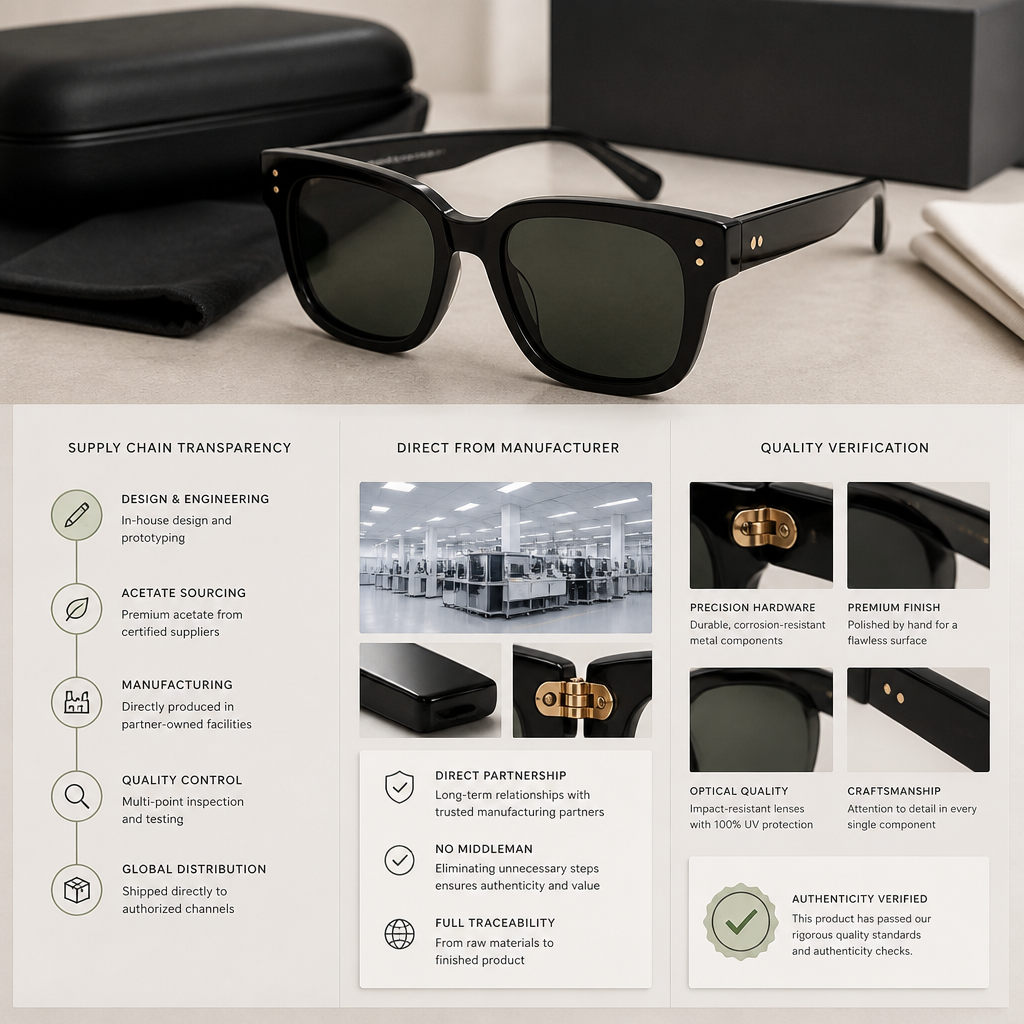
The most effective way to eliminate the risk of counterfeits is to establish a transparent, unbroken supply chain. When a frame is pulled straight from official, factory-approved stock, every pair comes with the original manufacturer's warranty and full post-purchase support.
The Authenticity Markers That Actually Matter
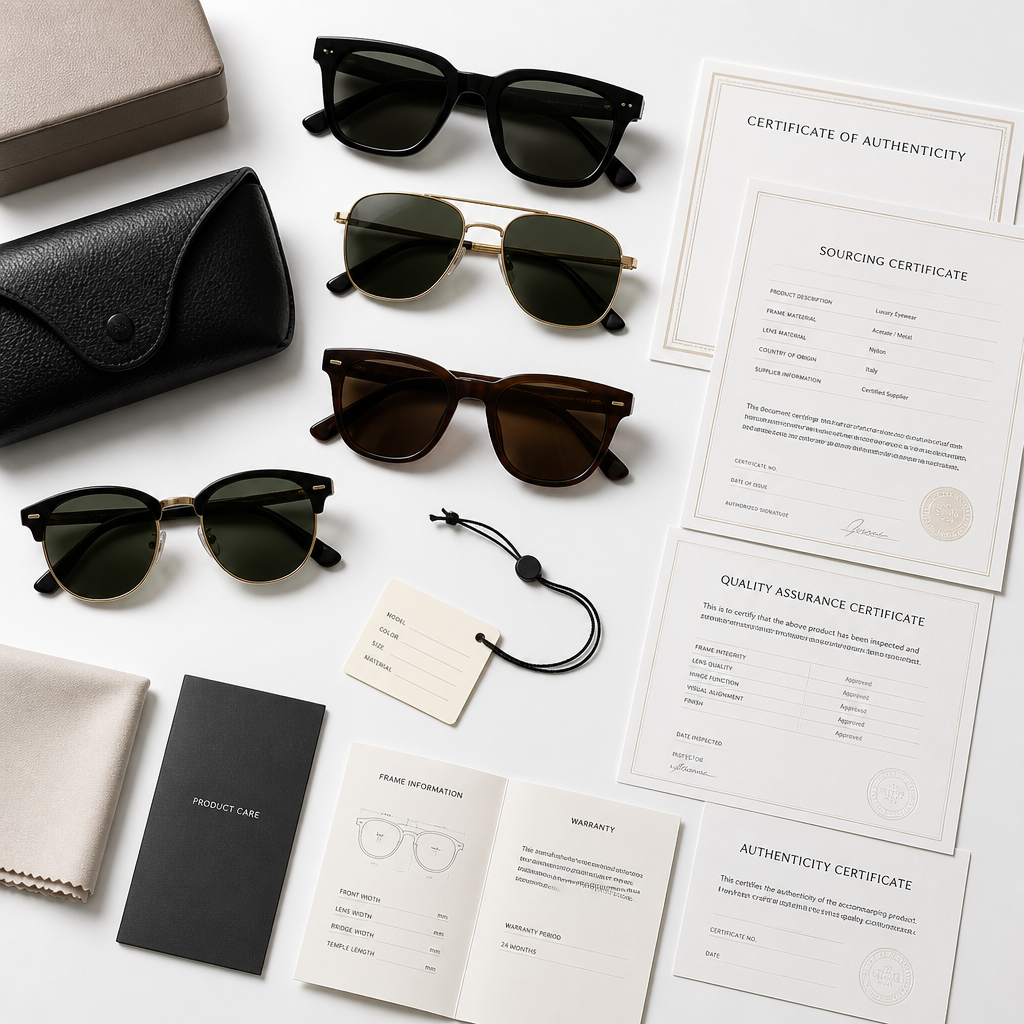
Retailers that source directly from brands receive the same packaging, documentation, and physical products that the brand's own boutiques stock. Knowing what those markers look like lets you verify a retailer's claims before you hand over your money.
Packaging Integrity
Authentic designer sunglasses arrive in brand-specific cases with consistent stitching, accurate logo placement, and branded microfibre cloths. Counterfeit packaging often looks convincing at a glance but shows imprecise printing, incorrect font weights, or slightly wrong colour tones when compared side by side with genuine product. The case hinge and clasp quality on real frames also differs noticeably from imitations.
Documentation and Authenticity Cards
Most premium eyewear brands include limited product warranties that are only valid when the product is purchased from an authorized retailer. Genuine Prada, Dior, and Emporio Armani sunglasses typically include authenticity cards or certificates with product details. These documents are printed specifically and are not available to grey-market or counterfeit operators. If a seller cannot provide original documentation, that is a clear signal to investigate further.
Lens and Frame Markings
Authentic frames carry specific engravings and markings etched directly into the material, not applied as stickers or surface prints. On genuine Ray-Ban frames, for instance, the logo appears on the lens itself, engraved cleanly and consistently. Model numbers, frame size measurements, and colour codes are stamped inside the temple arm and must match the brand's official catalog exactly. Counterfeit pairs frequently get these details wrong: misspellings, incorrect font sizes, or mismatched model numbers are common tells.
Pro tip: Before buying any pair of designer sunglasses online, search the exact model number on the brand's official website. If the colour code or frame size on the product listing does not match what the brand lists for that model, treat it as a red flag and ask the retailer for clarification in writing.
Why Counterfeit Sunglasses Are a Health Risk, Not Just a Style Problem
The damage caused by fake sunglasses goes well beyond wasting money on a poor imitation. Counterfeit lenses are rarely manufactured to any optical standard. They may be made from basic plastic that blocks visible light but provides no UV protection at all. This creates a dangerous effect: the tinted lens reduces the brightness reaching your eye, which causes your pupil to dilate, but the full spectrum of UV radiation passes through unfiltered. The result is greater UV exposure than if you wore no sunglasses at all.
In a region like the UAE, where solar intensity is consistently high year-round, this matters more than in markets with milder climates. Cumulative UV exposure without proper protection is linked to conditions including cataracts, photokeratitis, and macular degeneration. When you buy no middleman sunglasses UAE sourced directly from the brand, you are buying lenses that have been manufactured and tested to the brand's optical specifications, not replicated from a photo of the original.
Legitimate premium brands invest heavily in lens engineering. The UV protection in a genuine pair of Ray-Bans or Prada sunglasses is not a marketing feature: it is built into the lens material itself, verified during manufacturing, and consistent across every unit. That quality control simply does not exist in counterfeit production.
Pro tip: Ask any online retailer whether their sunglasses come with the manufacturer's original warranty card. An authorized retailer sourcing directly from the brand will always be able to say yes. If the answer is vague or the warranty card is absent from the product listing, that is worth investigating before purchase.
Sourcing Models Compared: How Retailers Actually Get Their Stock
Not every retailer that claims to sell genuine designer sunglasses uses the same sourcing method. Understanding the differences explains why prices, warranty availability, and authenticity guarantees vary so much across the market.
| Sourcing Model | How It Works | What the Buyer Gets |
|---|---|---|
| Direct from manufacturer or authorized distributor | Retailer holds a formal agreement with the brand or its regional master distributor. Stock is pulled from official, factory-approved inventory. | Full authenticity guarantee, original packaging and documentation, manufacturer's warranty, consistent quality across every unit. |
| Grey-market import | Retailer purchases genuine product from unofficial channels, often at steep discounts from overseas markets where pricing differs. Product may be real but is not authorized for the market in which it is sold. | Product may be genuine but manufacturer's warranty is typically void. Packaging may be missing or substituted. No brand support if the product has a defect. |
| Third-party marketplace or unverified wholesaler | Retailer sources from liquidation lots, unverified wholesalers, or peer-to-peer platforms where chain of custody is unknown. | Highest risk of counterfeit or damaged product. No warranty, no authenticity documentation, and no recourse if the product is fake. |
The direct sourcing model costs more to operate, which is why it is less common than the alternatives. Retailers who cut out the middleman by maintaining formal brand relationships pass a portion of that efficiency to the buyer in the form of fair pricing, not rock-bottom discounts that should raise questions.
A common mistake buyers make is equating "significantly cheaper than everywhere else" with "good deal." When a current-season Ray-Ban or Prada model appears at a price dramatically below what authorized retailers charge, the most likely explanation is not that the seller found some hidden efficiency: it is that the product is grey-market stock, a previous-season item being mislabeled, or outright counterfeit. Brands like EssilorLuxottica actively enforce pricing policies with their authorized network, which is why genuine authorized retailers tend to price within a similar range.
How to Verify Authenticity Before You Buy
Knowing the theory of what authentic means is useful, but knowing the practical checks you can run before handing over payment is more useful. Here is what to actually do.
Check Whether the Retailer Is Listed as Authorized
Most major eyewear brands maintain a public list of authorized retailers on their official websites. Before you buy, search for the retailer by name or website on the brand's authorized dealer directory. If the retailer is not listed and cannot explain why (for instance, because they source through an authorized regional distributor who is listed), ask the question directly and in writing.
Inspect the Product Listing for Specific Detail
Authorized retailers sourcing directly from brands can describe their products with the same precision the brand uses, because they have access to the same documentation. Look for accurate model numbers, correct color codes using the brand's naming system, frame measurements in millimeters, and lens material descriptions. Vague listings that describe a product as "Ray-Ban style" or omit the model number entirely should be avoided.
Confirm What Comes in the Box
Genuine designer sunglasses come in the original branded case, with the brand's microfibre cleaning cloth, a warranty or authenticity card, and sometimes care instructions specific to the frame material. If a product listing shows a generic case or does not specify what documentation is included, that is worth questioning before you purchase.
Check Return and Warranty Policy
A retailer confident in the authenticity of their stock will stand behind it with clear return and warranty terms. Look for a stated return window, a process for raising authenticity concerns, and clarity on whether the manufacturer's warranty transfers to you as the buyer. Vague or non-existent return policies on designer eyewear are a consistent warning sign.
What "No Middleman" Means for Buyers in the UAE
The traditional luxury eyewear supply chain in most markets runs through several layers: manufacturer, regional distributor, national importer, wholesale agent, and finally the retail store. Each layer adds a markup. By the time the product reaches the consumer, the price reflects not just the quality of the product but the commercial margin of every intermediary who handled it.
A retailer that sources no middleman sunglasses UAE by going direct to the manufacturer or authorized distributor eliminates those intermediate markups. The saving does not necessarily mean the product is priced below every other retailer: it means the buyer is paying for the product itself, not for the logistics of five different commercial relationships.
In the UAE specifically, the eyewear market includes a significant volume of counterfeit and grey-market product, particularly through informal retail channels and unverified online marketplaces. Buyers who have been burned by counterfeits often assume that paying more at a well-known physical retailer is the only safe option. Direct-from-brand online retailers change that calculation. When the supply chain is transparent and the sourcing relationship is formal, online purchasing is at least as safe as buying in-store, and often more convenient.
At Sunglass Hub, the sourcing model is built on a family legacy in optical retail and direct relationships with the brands themselves. That means every Ray-Ban, Prada, Dior, and Emporio Armani frame comes with the original brand packaging, documentation, and warranty, delivered free anywhere in the UAE. The option to pay cash on delivery exists specifically for buyers who want to inspect the product before committing, which is a further expression of confidence in what is being sold.
Pro tip: If you are buying designer sunglasses online in the UAE and want to verify authenticity after receiving your order, look up the frame's model number on the brand's official global website and compare it against the physical product: the engraving inside the temple arm, the case markings, and the lens etching. If anything does not match, a retailer with a genuine returns policy will resolve it. One that does not have that policy probably anticipated this question.
Frequently Asked Questions
What is the difference between authentic designer sunglasses and grey-market sunglasses?
Authentic designer sunglasses sourced through authorized channels come with the manufacturer's original warranty, full documentation, and genuine brand packaging. Grey-market sunglasses may be physically genuine products but are sold outside the brand's authorized distribution network, often from markets where they were priced differently. Because they are not authorized for the market where you buy them, the manufacturer's warranty is typically void and the brand will not support you if there is a defect.
How do I know if an online retailer is actually authorized to sell designer eyewear?
The most reliable check is to look up the retailer on the brand's official website, where most major brands publish their list of authorized sellers. You can also ask the retailer directly for evidence of their authorized retailer status and whether the product comes with the original manufacturer's warranty. A retailer that sources directly from the brand or its official distributor will be able to answer that question clearly and quickly.
Can counterfeit sunglasses actually damage my eyes?
Yes, and the risk is real. Counterfeit lenses are frequently made from basic materials that block visible light but do not filter UV radiation. The dark tint causes your pupils to dilate, which means more UV radiation reaches your retina than if you wore no sunglasses at all. Genuine designer sunglasses are manufactured to specific optical standards with UV protection built into the lens material itself.
Why are prices for the same model different across various retailers?
Pricing differences reflect sourcing models. Retailers who maintain formal brand relationships and source directly typically price within a similar range because the brands enforce minimum advertised price policies with their authorized network. Prices significantly below that range usually indicate grey-market stock, older unsold inventory being presented as current season, or counterfeit product. Extremely low prices for current-season luxury eyewear are a consistent warning sign, not a bargain.
What should be included in the box when I buy authentic designer sunglasses?
Authentic designer sunglasses should arrive in the original branded case with the brand's own microfibre cleaning cloth, a warranty or authenticity card, and any care instructions the brand includes. Some brands also include a branded outer box or pouch. If any of these items are missing or replaced with generic alternatives, ask the retailer to explain before you accept the order. A legitimate retailer with direct brand sourcing will be able to confirm exactly what comes in the package before you buy.
Does "no middleman" mean the sunglasses will always be cheaper?
Not always cheaper than every other seller, but fairer in what you are paying for. Removing intermediate layers in the supply chain means the price reflects the actual cost of the product and the retailer's service, rather than the accumulated margins of multiple middlemen. In practice, you are more likely to get a price that is competitive with authorized retail elsewhere, without paying the markup associated with physical luxury retail store overhead or multi-tier distribution.
Is it safe to pay cash on delivery for designer sunglasses in the UAE?
Cash on delivery is one of the most buyer-friendly payment options available for online eyewear purchases. It allows you to inspect the product, verify the packaging and documentation, and confirm authenticity before you hand over payment. Retailers that offer cash on delivery for designer eyewear are making a clear statement: they are confident enough in their product that they are willing to let you check it first. That confidence is itself a form of authenticity guarantee.
Have you had an experience buying designer sunglasses online in the UAE where authenticity turned out to be different from what was advertised? Share what you noticed in the comments, it helps other buyers know what to look for.
References
- How to identify authenticity markers on designer sunglasses by examining logos, packaging, and documentation
- How to verify genuine Ray-Ban sunglasses through packaging, lens markings, and pricing signals
- Authentic versus counterfeit Prada sunglasses: a detailed inspection checklist
- The counterfeit designer sunglasses market and its risks to consumer health and brand value
- How a transparent, direct supply chain guarantees authentic designer eyewear and manufacturer warranty coverage


