


Best Sunglasses for Desert Safaris in the UAE
A desert safari in the UAE is not a casual afternoon stroll. Dune bashing across the Al Marmoom dunes, sandboarding at speed, and sitting around a Bedouin camp as the sun drops low all expose your eyes to conditions most sunglasses are simply not built for. The UV index in Dubai regularly hits 9 (Very High), sand reflects light upward from below, and the wind kicks fine particles into your face at every turn. Choosing the right sunglasses for a desert safari in the UAE is a practical decision as much as a style one, and getting it wrong means squinting through a once-in-a-lifetime experience or, worse, long-term eye damage from sustained UV exposure.
Table of Contents
- Quick Takeaways
- Why the UAE Desert Is Brutal on Your Eyes
- What to Look For in Outdoor Sunglasses for Dubai
- Lens Category Guide for Desert Conditions
- Best Sunglass Styles for Desert Adventures
- Polarized vs. Non-Polarized Sunglasses in the UAE
- Comparison: Top Approaches to Desert Eye Protection
- How to Keep Your Sunglasses Functional in the Sand
- Frequently Asked Questions
- References
Quick Takeaways
| Key Insight | Explanation |
|---|---|
| UV400 is the minimum standard for UAE conditions | The UAE's UV index regularly reaches 9 (Very High). A UV400-rated lens blocks all wavelengths up to 400nm, covering both UVA and UVB rays completely. |
| Polarized lenses are essential in the desert | Sand reflects light horizontally, creating ground-level glare that standard tinted lenses cannot eliminate. Polarized lenses cut this reflected glare at the source. |
| Category 3 or 4 lenses, nothing lower | Cat 3 lenses block 82-92% of light; Cat 4 lenses block 92-97%. Cat 4 is ideal for open dune environments but cannot legally be worn while driving. |
| Wraparound fit beats a standard frame in sand | Fine desert sand enters from every angle. A close-fitting wraparound or semi-rimless frame reduces direct eye exposure from the sides and above. |
| Lens material matters for impact and weight | Polycarbonate and Trivex lenses are impact-resistant and lightweight, which matters during dune bashing and sandboarding when vibration and dust are constant. |
| Dark lenses do not equal UV protection | A very dark tint without a proper UV coating can actually worsen eye damage, because the pupil dilates behind the dark lens while UV still passes through. |
| Anti-reflective coatings on the rear surface help | Rear-surface AR coating prevents UV from bouncing off the inside of the lens back onto the eye, a problem particularly acute when the sun is behind and low. |
Why the UAE Desert Is Brutal on Your Eyes
Dubai's UV index peaks at 9 (Very High) on a regular basis, including through the autumn months when desert safaris are most popular. That number places it well above what most people in Europe or North America ever experience, and it stays elevated for the majority of daylight hours rather than just a midday spike.
The desert compounds the problem in a way the coast does not. Sand is a natural reflector. Light hits the dune surface and bounces back upward, meaning your eyes receive UV radiation from above and below simultaneously. This double exposure significantly increases cumulative dose over a 4-6 hour safari outing.
Add wind-blown particles, the fine silt that gets everywhere during dune bashing, and the fact that you are often outdoors without shade for extended periods, and you have an environment that demands more from eyewear than almost any urban setting can replicate. A pair of fashion sunglasses with no certified UV rating is not adequate here. It is not even close.
The most important factor is whether the sunglasses carry a UV400 rating. Many affordable sunglasses provide the same level of UV protection as premium designer brands when they meet these standards, but many do not, and the label is the only way to know for certain.
What to Look For in Outdoor Sunglasses for Dubai
The checklist for outdoor sunglasses in Dubai is short, but each item matters. Start with UV400 certification, the baseline that guarantees complete blockage of UVA and UVB rays. Without it, nothing else on the frame matters.
Frame Fit and Coverage
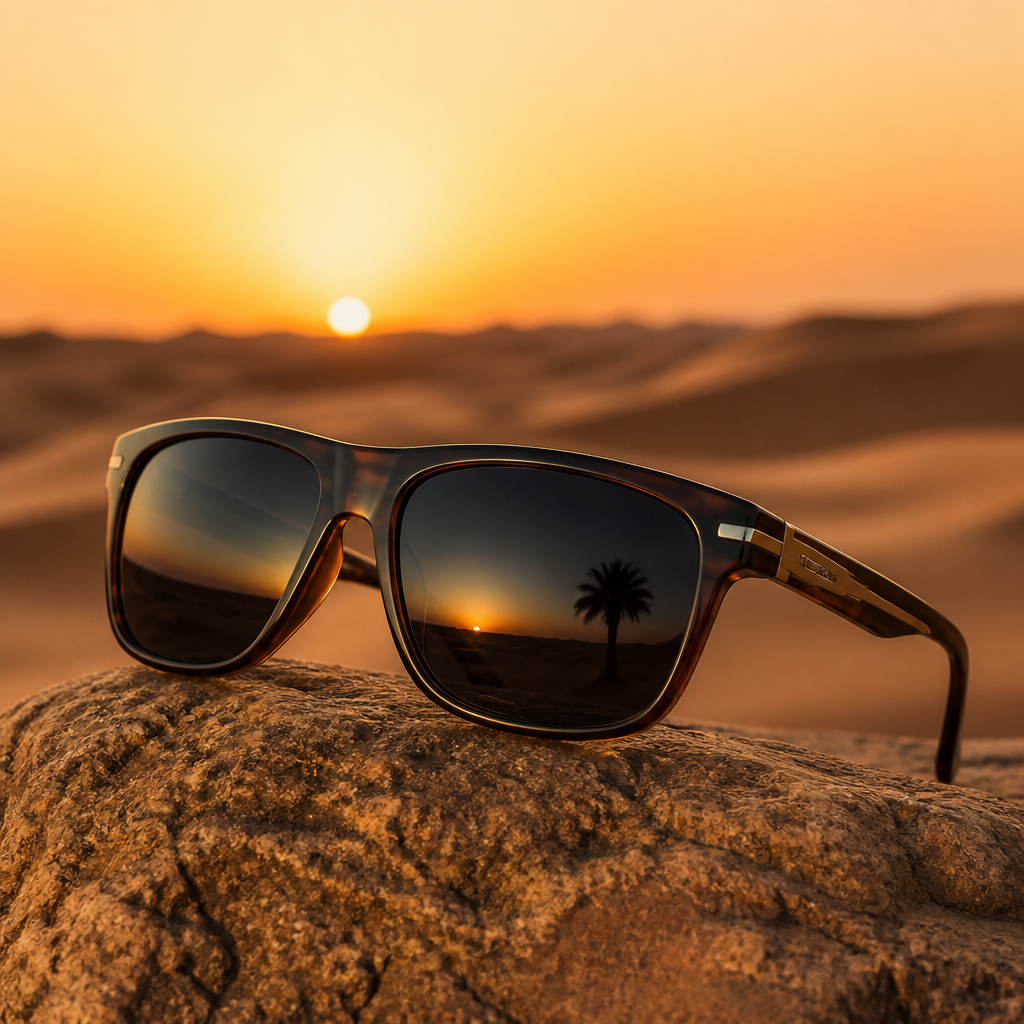
A standard medium-sized frame with open sides leaves a significant portion of the eye area unprotected, especially from lateral light. Research published in the Journal of Exposure Science and Environmental Epidemiology found that large-framed sunglasses provided substantially better protection than medium-sized ones, with goggles offering the highest protection overall. For a desert safari, a large frame with close temple coverage is the practical minimum. Full wraparound styles, common in sports eyewear, are the optimal choice.
Frame material also plays a role. Lightweight frames with rubberized nose pads and temple tips stay in place during active movement. When you are bouncing across dunes in a Land Cruiser, a frame that slides down every 30 seconds becomes useless. Look for frames with adjustable nose bridges or rubberized grip elements, common features in brands like Ray-Ban's sport line and Porsche Design's active collections.
Lens Colour for Desert Light
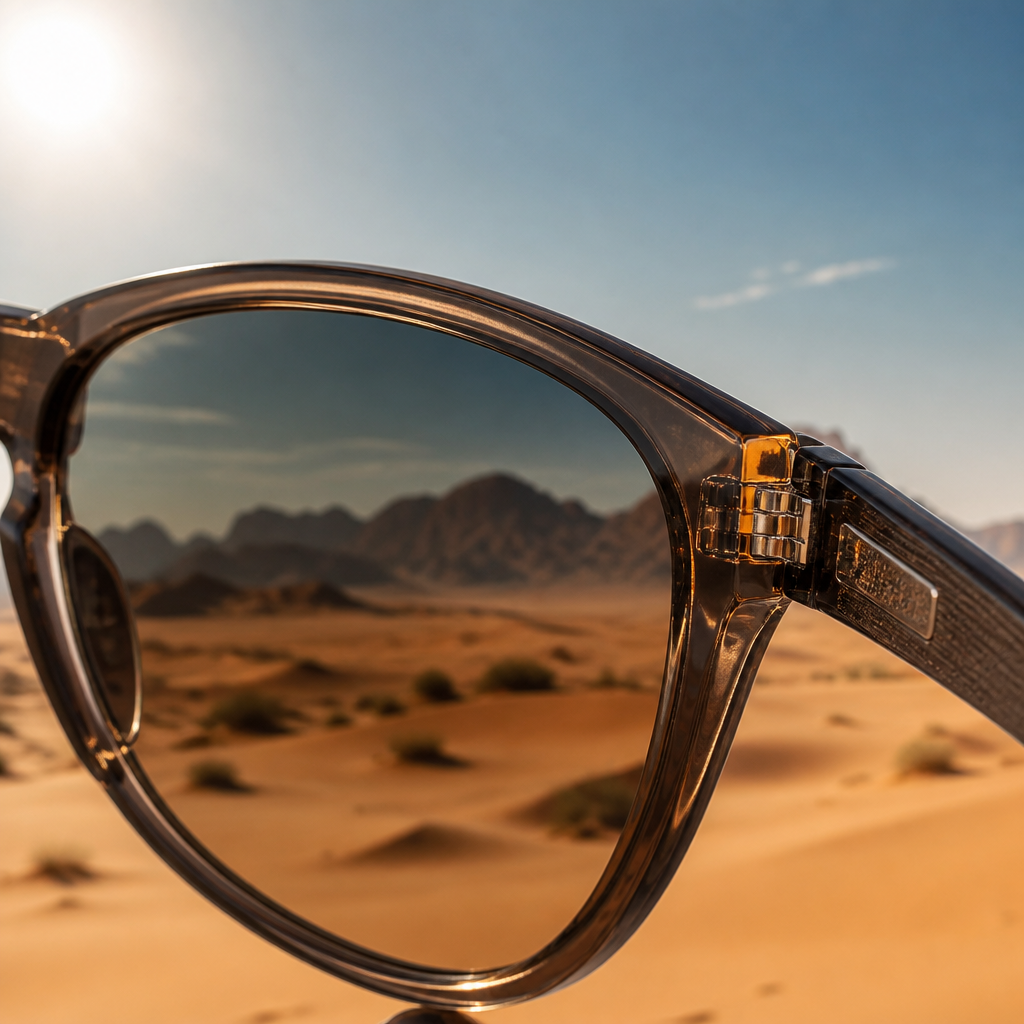
Grey and green lenses are the safest choice for desert environments because they reduce overall brightness without distorting colour perception. Brown and amber lenses enhance contrast, which can make distinguishing terrain features and depth easier on sandy terrain, a real benefit during sandboarding or quad biking. Avoid mirrored lenses as your only protection: the mirror coating reduces visible glare but does not independently add UV protection unless the base lens is already UV400-rated.
Pro tip: If you are doing a sunset safari, grey lenses are preferable to amber. Amber enhances warm tones, which makes the already-golden desert light even harder to manage as the sun drops to eye level and shines directly at you.
Lens Category Guide for Desert Conditions
The lens category system (0-4) measures how much visible light passes through the lens, known as Visible Light Transmission (VLT). The lower the VLT, the darker the lens and the more light it blocks. For the UAE desert, category 3 is the minimum sensible choice. Category 4 is the maximum available on the market.
Category 3 lenses allow 8-18% of visible light to reach the eye, blocking 82-92% of light. They are suitable for bright sunlight at the beach, in the mountains, or in open desert terrain. The vast majority of quality designer sunglasses from brands like Ray-Ban, Prada, and Emporio Armani ship with Category 3 lenses as standard, making them the most practical choice for most desert safari-goers.
Category 4 lenses allow as little as 1-8% of visible light through, blocking 92-97%. They are ideal for extreme high-brightness environments, such as open dunes at midday with no shade. The important caveat: Category 4 lenses are not suitable for driving. If your safari involves driving to the dune site in a vehicle, pack a Category 3 pair for transit and switch to Category 4 once you are out on foot or in a specialist dune vehicle.
Pro tip: When buying sunglasses for a desert safari, check the lens category label on the product page, not just the UV400 rating. A lens can be UV400-rated at Category 2, which is too light for intense desert conditions. You want both: UV400 certification AND Category 3 or 4 lens darkness.
Best Sunglass Styles for Desert Adventures
Not every sunglass style is equally suitable for open desert terrain. Some are better suited to the specific demands of dune bashing, sandboarding, and extended outdoor exposure in the UAE.
Aviators
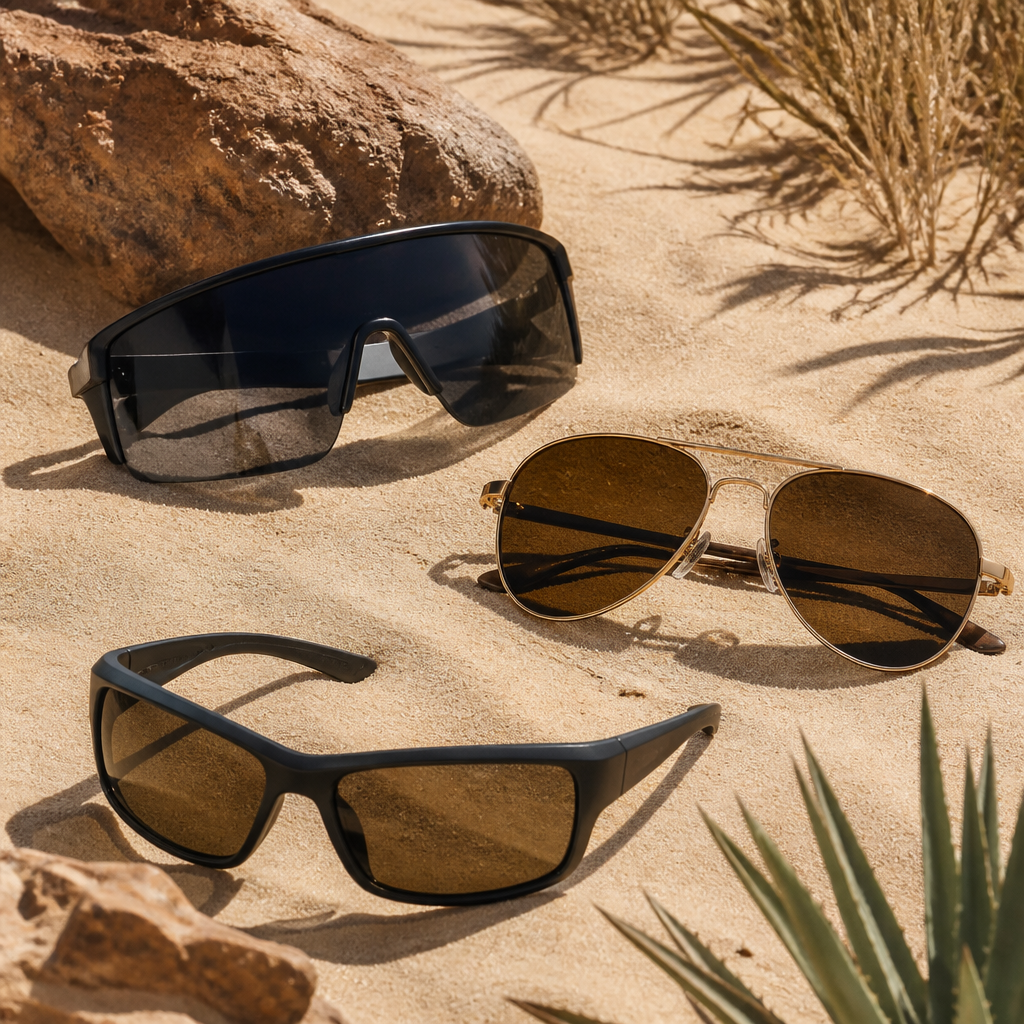
The classic aviator shape, most associated with Ray-Ban, offers substantial lens area and good downward coverage. The teardrop lens shape naturally extends below the eye, protecting from upward sand reflection. The metal frame is lightweight and durable. The limitation is the open top bar, which allows some light to enter from above. For a classic-looking option that still performs well in the desert, polarized aviators in Category 3 are a solid choice.
Shield and Sport Wraparound Frames
A single-lens shield or wraparound sport frame provides the closest thing to full surround protection without going into goggle territory. These frames wrap around the face, reducing side-entry glare and keeping wind-blown particles away from the eye corner. Brands like Prada Linea Rossa and Porsche Design produce sport-oriented frames that combine performance lens technology with premium aesthetics. For active desert pursuits, this category is the most practical.
Oversized Frames
Oversized frames have moved well beyond fashion territory into legitimate sun protection. A large frame from Dior or Emporio Armani that sits close to the face, with wide temples and generous vertical lens height, provides more eye area coverage than a compact frame. For camel riding and desert camp evenings where you want style and protection without the overtly sporty look, oversized frames in a Category 3 polarized lens are the right balance.
Polarized vs. Non-Polarized Sunglasses in the UAE
This is not a close debate for desert conditions. Polarized sunglasses are worth the price premium in the UAE, full stop. Here is the technical reason: polarization works by filtering horizontal light waves, which are the type produced when light bounces off flat surfaces like water, glass, and, crucially, sand.
When you are standing on a dune and the sun is at a low angle, the sand surface acts like a mirror. Non-polarized Category 3 lenses will reduce the overall brightness, but they will not eliminate the specific horizontal glare coming from the ground. Polarized lenses cut that glare completely, reducing eye fatigue significantly over a 4-6 hour outdoor session.
The practical difference shows up most clearly during dune bashing. In a non-polarized lens, the sand ahead looks uniformly bright and slightly washed out. In a polarized lens, you get defined contrast and depth, which makes the experience visually richer and far less tiring on the eyes.
The one context where polarization can be a disadvantage is reading LCD screens, such as GPS devices, where polarization can make the display hard to read at certain angles. For a desert safari where you are a passenger and not navigating, this is not a relevant concern.
Comparison: Top Approaches to Desert Eye Protection
| Lens Type | Protection Level | Best For |
|---|---|---|
| Category 3 Polarized, UV400 | Excellent: blocks 82-92% of light, eliminates sand glare, full UV coverage | Most desert safari activities including dune bashing, camel riding, and sunset camps. Safe for vehicle transit. |
| Category 4 Non-Polarized, UV400 | Maximum tint: blocks 92-97% of light, full UV, but no glare filtering | Midday open-dune hiking or sandboarding where direct overhead sun is the primary concern. Not for driving. |
| Category 2 Fashion Tint, UV400 | Adequate UV coverage, but only 18-43% light blockage, too bright for desert noon | Light outdoor use, indoor-outdoor settings, or overcast UAE days only. Inadequate for full desert exposure. |
How to Keep Your Sunglasses Functional in the Sand
Desert sand is extraordinarily fine and abrasive. Even premium anti-scratch-coated lenses can be damaged if you wipe sand off them dry. This is one of the most common mistakes safari-goers make: using a shirt or tissue to brush sand off the lens while still in the field, creating micro-scratches that permanently haze the surface.
Always carry a sealed lens cleaning kit: a small bottle of lens cleaning solution and a microfibre cloth in a sealed pouch. When sand lands on the lens, rinse it away with the solution first, never wipe dry. If you have no solution, leave it and clean properly later rather than risking the lens.
Storage matters as much as cleaning. A hard-shell case prevents the frame from being crushed in a bag full of desert gear and keeps sand from settling onto the lens surface during transport. Most premium frames from brands stocked at Sunglass Hub come with branded hard cases as standard. Use them every time you are not wearing the glasses, not just on the trip home.
Strap accessories are worth considering for active sessions. A rubberised eyewear retainer cord keeps the frame on your face during dune bashing without putting constant pressure on the nose bridge. Many sports eyewear frames have built-in retainer loops; if yours does not, a simple aftermarket strap solves the problem for a few dirhams.
Pro tip: After a desert safari, rinse your frames and lenses with clean water before using the microfibre cloth. Sand particles embedded in the cloth will scratch the lens just as effectively as wiping the lens directly with grit. Rinse both the cloth and the lenses before cleaning.
Frequently Asked Questions
What UV rating do I need for sunglasses in the UAE desert?
You need a minimum of UV400 certification, which guarantees complete blockage of UVA and UVB radiation up to 400 nanometres. In the UAE, where the UV index regularly reaches 9 (Very High), this is not optional. Check that the product listing specifically states UV400, not simply "UV protection," as the latter can refer to lower levels of coverage.
Are polarized sunglasses worth it for a desert safari?
Yes, without question. Sand reflects horizontal light waves that create ground-level glare, exactly the type of glare polarized lenses are engineered to eliminate. Over a 4-6 hour safari, the reduction in eye fatigue from polarized lenses is noticeable. They also improve visual contrast on the dunes, making the landscape appear sharper and more defined.
Can I wear Category 4 sunglasses during dune bashing in a 4x4?
Category 4 lenses are too dark for driving and should not be used while operating or sitting in the front of a moving vehicle where the driver's visibility is affected. However, if you are a back-seat passenger during dune bashing, the practical impact is minimal. The restriction is a legal and safety standard for driving, not for passive transit. Bring a Category 3 pair as your primary and switch to Category 4 only when you are on foot in open terrain at peak brightness.
Which sunglass frame styles are best for sandboarding and active desert sports?
Wraparound and shield-style frames are the best choice for sandboarding and quad biking because they reduce the entry points for sand and wind-blown particles around the eye. Sport frames from lines like Prada Linea Rossa or Ray-Ban's active collections are designed for exactly this kind of movement. Avoid narrow frames, open rimless styles, or frames with wide gaps at the temples for any activity involving speed and dust.
Does a darker lens always mean better protection in the desert?
No, and this is a critical point. Lens darkness (the VLT or tint) and UV protection are two separate properties. A lens can be very dark and still pass UV radiation if it lacks a proper UV coating. Conversely, a lighter-tinted lens with proper UV400 certification will protect your eyes fully. Always check the UV rating, not just the visual darkness of the lens.
How do I clean sand off my sunglasses lenses without scratching them?
Never wipe sand off a dry lens. Always rinse the lens with lens cleaning solution first to float the sand particles off the surface before any cloth contact. In the field, if you have no solution, leave the sand in place and clean properly when you return to your accommodation. Even premium anti-scratch coatings are vulnerable to the ultra-fine abrasive particles found in UAE desert sand.
Where can I find authentic designer polarized sunglasses for delivery in the UAE?
Sunglass Hub stocks a curated range of authentic designer eyewear including Ray-Ban, Prada, Dior, Emporio Armani, and Porsche Design, all sourced directly from manufacturers with 100% authenticity guaranteed. Products are available with free UAE delivery and a 7-day return policy, with cash on delivery available as a payment option. Browse the full polarized collection at sunglasshub.com to find frames suited to desert and outdoor use.
Have a favourite pair of sunglasses you have taken on a UAE desert safari? Share your experience in the comments, we would love to know which frames held up best in the dunes.
References
- Gulf News: UAE eye specialists explain UV protection standards and what to look for in sunglasses
- Journal of Exposure Science and Environmental Epidemiology: Research on predicted UV protection effectiveness of different sunglass frame sizes
- The Weather Network: Dubai daily UV index data and forecast
- SmartBuyGlasses Optical Center: Explanation of UV sunglasses lens protection categories 0 through 4
- Desert Buggy Rental: Guide to dune bashing activities and what to bring for a desert safari in Dubai


